Income Tax Returns Filing 2026: Complete Guide to ITR Filing for AY 2026-27
Income Tax Return (ITR) filing for the Financial Year 2025-26 (Assessment Year 2026-27) has commenced. Salaried employees, pensioners, business owners, and eligible taxpayers are advised to file their income tax returns within the prescribed deadline to avoid penalties and ensure smooth processing of refunds. The Income Tax Department has introduced several updates in ITR forms this year, making the filing process easier for many taxpayers.
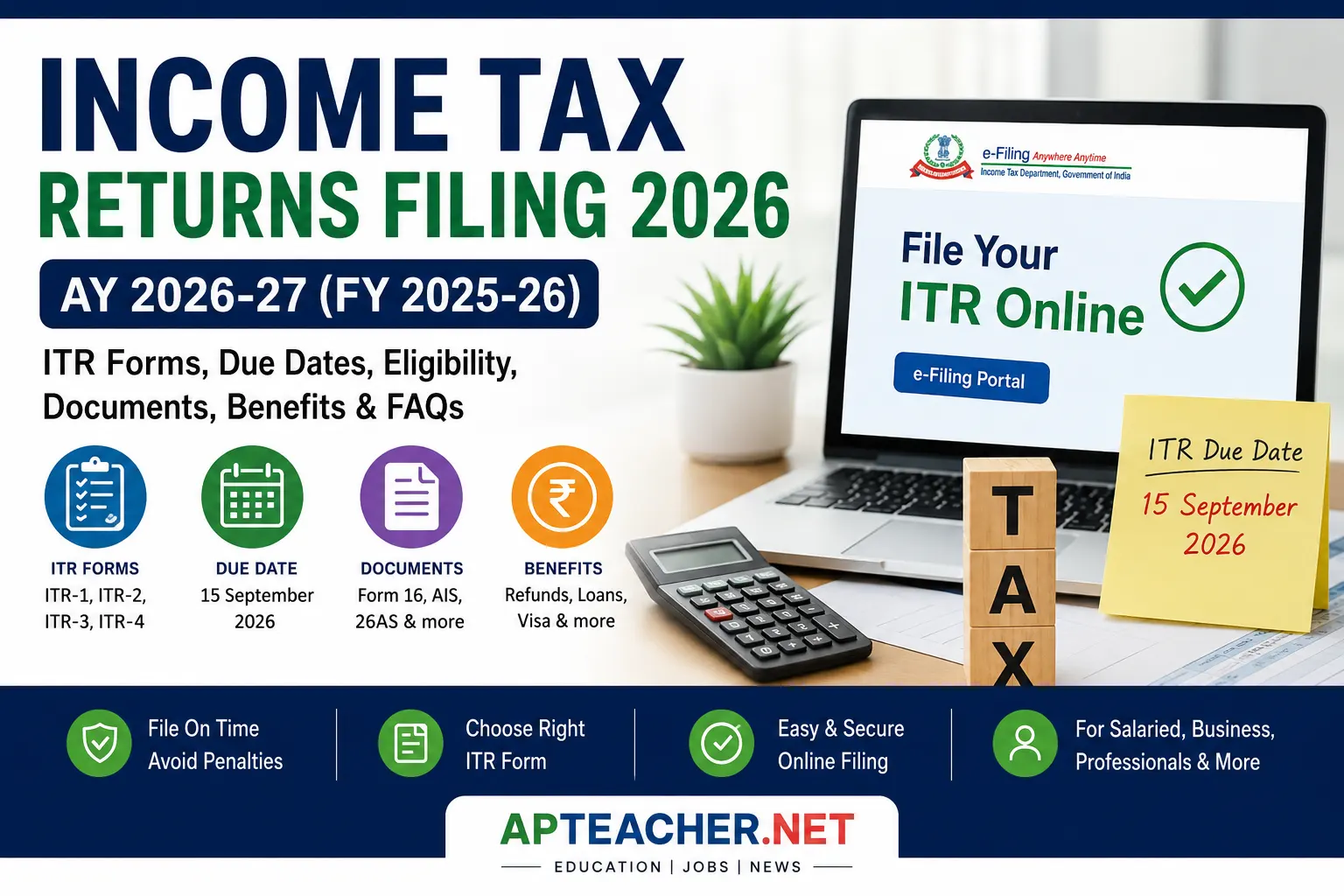
Table of Contents
Overview of Income Tax Return Filing 2026
| Particulars | Details |
|---|---|
| Financial Year | 2025-26 |
| Assessment Year | 2026-27 |
| Applicable To | Salaried Employees, Pensioners, Business Owners, Professionals |
| ITR-1 & ITR-4 Due Date | 15 September 2026 |
| Authority | Income Tax Department of India |
| Mode of Filing | Online |
Major Changes in ITR Forms for AY 2026-27
The Income Tax Department has made several modifications to the ITR forms to simplify compliance and improve reporting accuracy. Taxpayers should carefully review the updated forms before filing their returns.
- Simplified reporting requirements for eligible taxpayers.
- Enhanced disclosure requirements for certain income categories.
- Improved validation checks to reduce filing errors.
- Streamlined process for reporting capital gains and deductions.
- Better integration with AIS and Form 26AS data.
ITR Filing Due Dates 2026
Taxpayers must file their returns before the prescribed deadline to avoid penalties and interest charges.
| Category | Due Date |
|---|---|
| ITR-1 and ITR-4 Filers | 15 September 2026 |
| Other Non-Audit Cases | As notified by the Income Tax Department |
| Audit Cases | As per applicable provisions |
Late filing may attract penalties, interest on tax dues, and delays in refund processing.
Which ITR Form Should You Use?
ITR-1 (Sahaj)
Suitable for individuals having:
- Income from salary or pension.
- Income from one house property.
- Income from other sources such as interest.
- Total annual income up to ₹50 lakh.
ITR-2
Applicable for individuals with:
- Income exceeding ₹50 lakh.
- Capital gains from shares, property, or other assets.
- More than one house property.
- Foreign assets or foreign income.
ITR-3
For individuals and Hindu Undivided Families (HUFs) earning income from business or profession.
ITR-4 (Sugam)
Designed for small business owners and professionals opting for the presumptive taxation scheme.
Documents Required for Filing Income Tax Return
- PAN Card
- Aadhaar Card
- Form 16 issued by employer
- Bank Account Details
- AIS (Annual Information Statement)
- Form 26AS
- Investment Proofs and Deduction Documents
- Capital Gains Statements (if applicable)
Benefits of Filing Income Tax Returns
- Easy approval of home, personal, and education loans.
- Helpful for visa applications.
- Faster processing of tax refunds.
- Acts as proof of income.
- Helps maintain a clean financial record.
- Avoids legal complications and penalties.
Important Tips for Taxpayers
- Verify Form 16 details before filing.
- Cross-check AIS and Form 26AS data.
- Ensure PAN and Aadhaar are linked.
- Review bank account details carefully.
- Claim eligible deductions under relevant sections.
- Submit and e-verify the return after filing.
- Do not wait until the last date to file.
Conclusion
Income Tax Return filing is an important responsibility for every eligible taxpayer. Filing returns within the prescribed deadline ensures compliance with tax laws, facilitates refund processing, and strengthens your financial credibility. Taxpayers are advised to gather all necessary documents, choose the correct ITR form, and complete the filing process well before the due date.
Frequently Asked Questions (FAQs)
1. What is the due date for filing ITR-1 and ITR-4 for AY 2026-27?
The due date is 15 September 2026.
2. Who can file ITR-1?
Individuals earning up to ₹50 lakh from salary, pension, one house property, and other sources can file ITR-1.
3. What happens if I file my ITR after the due date?
Late filing may attract penalties, interest, and delays in receiving refunds.
4. Is Form 16 mandatory for filing ITR?
While not mandatory in all cases, Form 16 helps salaried employees accurately report income and taxes deducted.
5. Why is AIS important while filing ITR?
AIS contains details of income, investments, and tax-related transactions reported to the Income Tax Department.
6. Can I file my Income Tax Return online?
Yes. Income Tax Returns can be filed online through the Income Tax Department’s e-filing portal.
“`