Go.129 Guidelines for Allotment of Employees to Local Cadres in Andhra Pradesh 2026 – Complete Guidelines, Eligibility, Process & FAQs
The Government of Andhra Pradesh has issued comprehensive Guidelines for the Allotment of Employees to Local Cadres under the Andhra Pradesh Public Employment (Organisation of Local Cadres and Regulation of Direct Recruitment) Order, 2025. These guidelines explain the procedure for allotting employees working in different departments into newly constituted local cadres based on nativity, local candidature, seniority, reservation, and administrative requirements.
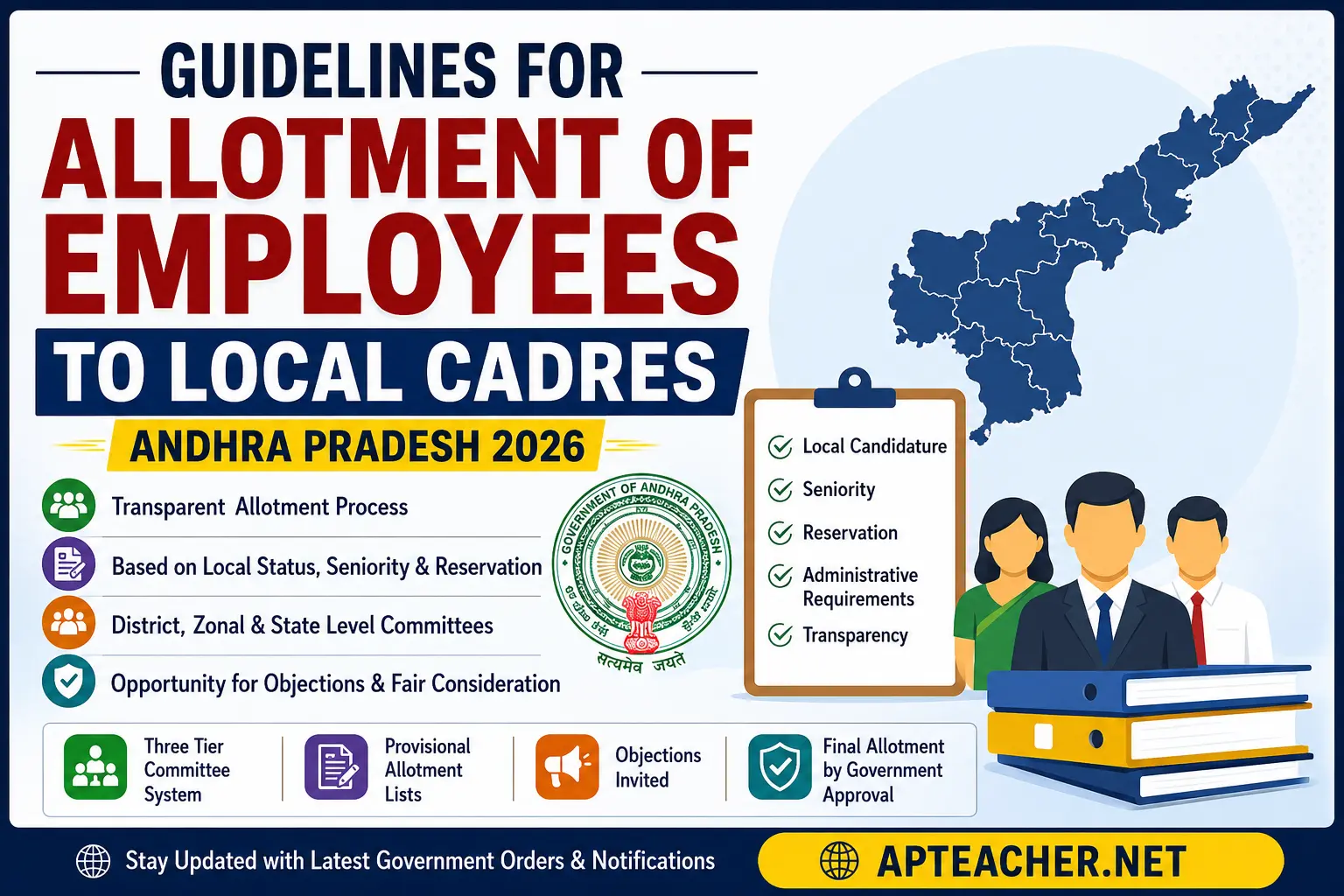
The objective of these guidelines is to ensure transparent, fair, and legally compliant allocation of employees while maintaining administrative efficiency across the State. The allotment process is supervised through District, Zonal and State Level Committees with provision for objections, appeals and final allotment.
This article explains the complete guidelines, eligibility conditions, committee structure, allotment principles, reservation policy, objection process, important dates, and frequently asked questions.
Download GO Ms No:129 Guidelines for Allotment of Employees to Local Cadres Click Here
Table of Contents
- Overview
- Background
- Objectives
- Implementation Committees
- Principles of Allotment
- Determination of Local Status
- Reservation Guidelines
- Allotment Process
- Documents Required
- FAQs
Overview of AP Employees Local Cadre Allotment Guidelines 2026
| Particular | Details |
|---|---|
| Notification | Guidelines for Allotment of Employees to Local Cadres |
| State | Andhra Pradesh |
| Issued By | Government of Andhra Pradesh |
| Applicable To | Government Employees |
| Based On | AP Public Employment Order, 2025 |
| Purpose | Allocation of employees into newly constituted Local Cadres |
| Implementation | District, Zonal & State Committees |
| Selection Basis | Local candidature, seniority, reservation, service records |
| Objections | Allowed before final allotment |
| Final Authority | Government of Andhra Pradesh |
Background
The Andhra Pradesh Public Employment (Organisation of Local Cadres and Regulation of Direct Recruitment) Order, 2025 was introduced to reorganize local cadres after administrative restructuring. Every department has been instructed to identify employees and allot them to appropriate local cadres by following a transparent procedure.
The allotment exercise aims to minimize disputes while protecting the service rights of employees and ensuring that local reservation policies are implemented effectively.
Objectives of the Guidelines
- Ensure equitable allotment of employees.
- Maintain administrative efficiency.
- Protect employee seniority.
- Implement local reservation policy.
- Avoid unnecessary litigation.
- Provide transparent objection mechanism.
- Ensure proper distribution of manpower.
- Maintain continuity of public services.
Implementation Committees
1. District Level Committee
The District Level Committee is responsible for collecting employee data, verifying service particulars and preparing the initial allotment list.
Major Responsibilities
- Verification of employee records.
- Determination of local candidature.
- Preparation of provisional allotment.
- Inviting objections.
- Forwarding proposals to higher committee.
2. Zonal Level Committee
The Zonal Committee examines proposals received from districts and ensures uniform implementation of Government guidelines across all districts falling under the respective zone.
Functions
- Review district proposals.
- Resolve inter-district issues.
- Verify vacancy positions.
- Recommend modifications wherever necessary.
- Forward recommendations to State Committee.
3. State Level Committee
The State Level Committee acts as the highest authority for examining recommendations before submission to the Government for approval.
Responsibilities
- Examine departmental proposals.
- Ensure compliance with Presidential Order.
- Review reservation implementation.
- Approve final allotment proposals.
- Recommend Government orders.
Important Principles for Employee Allotment
| Principle | Description |
|---|---|
| Local Candidature | Primary consideration while allotting employees. |
| Seniority | Maintained within the cadre. |
| Reservation | Applicable Government reservation rules followed. |
| Administrative Need | Balanced manpower distribution. |
| Transparency | Provisional lists published before final orders. |
| Employee Rights | Opportunity to submit objections. |
Determination of Local Status
Local candidature plays an important role during the allotment process. The competent authority examines educational records, residence particulars, recruitment details and other supporting documents to determine the local area to which an employee belongs.
If any discrepancies are noticed, employees will be provided an opportunity to submit documentary evidence before the final allotment is approved.
Important Features of the Guidelines
- Transparent allotment process.
- Online and offline verification of records.
- Department-wise allotment.
- Employee grievance mechanism.
- Opportunity for corrections.
- Publication of provisional lists.
- Government approval before implementation.
Documents Likely to be Verified
- Service Register
- Appointment Order
- Educational Certificates
- SSC Study Certificate
- Local Status Certificate (where applicable)
- Promotion Orders
- Transfer Orders
- Seniority List
- Reservation Category Certificates
Reservation Guidelines During Employee Allotment
The Government has instructed all departments to strictly follow the applicable reservation policies while preparing the allotment lists. The reservation principles shall be implemented in accordance with the Andhra Pradesh Public Employment Order, 2025 and other Government instructions issued from time to time.
| Reservation Aspect | Guideline |
|---|---|
| SC/ST Reservation | Applicable as per Government rules. |
| Backward Classes (BC) | Reservation maintained according to existing norms. |
| Women Reservation | Applicable wherever prescribed. |
| Persons with Benchmark Disabilities | Protected as per Government policy. |
| Ex-Servicemen | Applicable wherever relevant. |
| Roster Points | Maintained according to approved roster registers. |
Step-by-Step Employee Allotment Process
The allotment process is carried out in multiple stages to ensure fairness and transparency.
- Collection of employee service particulars.
- Verification of service registers and appointment records.
- Identification of the appropriate local cadre.
- Verification of local candidature.
- Preparation of provisional allotment lists.
- Publication of provisional lists.
- Receiving objections and representations.
- Verification of objections by competent authority.
- Preparation of revised allotment list.
- Approval by the State Government.
- Issue of final allotment orders.
Publication of Provisional Allotment Lists
Before issuing the final allotment orders, every department shall publish provisional allotment lists. Employees are advised to carefully verify their particulars, including:
- Name and Employee ID
- Designation
- Department
- Present Place of Working
- Local Cadre Proposed
- Reservation Category
- Seniority Position
If any discrepancy is noticed, the employee may submit objections within the prescribed time.
Submission of Objections
Employees who are not satisfied with the provisional allotment may submit a representation to the competent authority within the time notified by the department.
The objection should clearly mention the reason along with supporting documentary evidence.
Common Reasons for Filing Objections
- Incorrect local status.
- Wrong seniority position.
- Errors in service particulars.
- Reservation category mistakes.
- Incorrect cadre allocation.
- Clerical or data entry errors.
Verification of Representations
All objections received from employees shall be verified by the concerned committee. Necessary records such as Service Registers, appointment orders, study certificates, transfer proceedings and seniority lists may be examined before taking a final decision.
The committee may accept or reject the representation based on documentary evidence and applicable Government rules.
Issue of Final Allotment Orders
After examining all objections, the competent authority shall prepare the final allotment proposals and submit them for Government approval. Once approved, the final allotment orders become binding on all concerned employees.
The allotment order will generally contain:
- Name of Employee
- Employee ID
- Department
- Present Unit
- New Local Cadre
- Place of Posting (if applicable)
- Date of Effect
Benefits of the New Local Cadre System
- Transparent administration.
- Uniform implementation across departments.
- Better manpower planning.
- Reduced inter-district disputes.
- Protection of employee service rights.
- Compliance with the AP Public Employment Order, 2025.
- Improved administrative efficiency.
- Fair distribution of employees among local cadres.
Important Instructions for Employees
- Verify all personal and service particulars immediately after publication of provisional lists.
- Keep original service records ready for verification.
- Submit objections only with supporting documents.
- Follow the timelines prescribed by the department.
- Regularly check official Government notifications for updates.
- Retain copies of all representations submitted.
Official Reference Links
Frequently Asked Questions (FAQs)
1. What are the Guidelines for Allotment of Employees to Local Cadres?
These are Government guidelines issued for allocating employees into newly constituted local cadres in Andhra Pradesh based on the AP Public Employment Order, 2025.
2. Who is covered under these guidelines?
The guidelines apply to eligible Government employees working in departments where local cadres are being reorganized.
3. How is local status determined?
Local status is generally determined based on educational records, recruitment details, residence particulars and other Government-prescribed criteria.
4. Will employees be allowed to raise objections?
Yes. Provisional allotment lists are published before the final orders, allowing employees to submit objections within the prescribed period.
5. Who approves the final allotment?
The Government of Andhra Pradesh issues the final allotment orders after considering the recommendations of the competent committees.
6. Are reservation rules applicable?
Yes. Reservation policies applicable to Government employees will be followed during the allotment process wherever relevant.
7. What documents may be required for verification?
Service Register, appointment orders, SSC study certificates, local status documents, seniority records and other supporting documents may be verified.
8. Where can employees check the latest updates?
Employees should regularly visit the official Andhra Pradesh Government website and departmental portals for notifications and allotment lists.