AP Thalliki Vandanam Scheme 2026-27: ₹15,000 Financial Assistance, Eligibility, Guidelines, DBT Payment & Complete Details
The Government of Andhra Pradesh has officially continued the Thalliki Vandanam Scheme for the Academic Year 2026-27 through G.O.Ms.No.15, School Education (Ser.I) Department, dated 16 July 2026. The flagship welfare programme aims to encourage school education by providing ₹15,000 per annum per child to every eligible mother or guardian through the Direct Benefit Transfer (DBT) system.
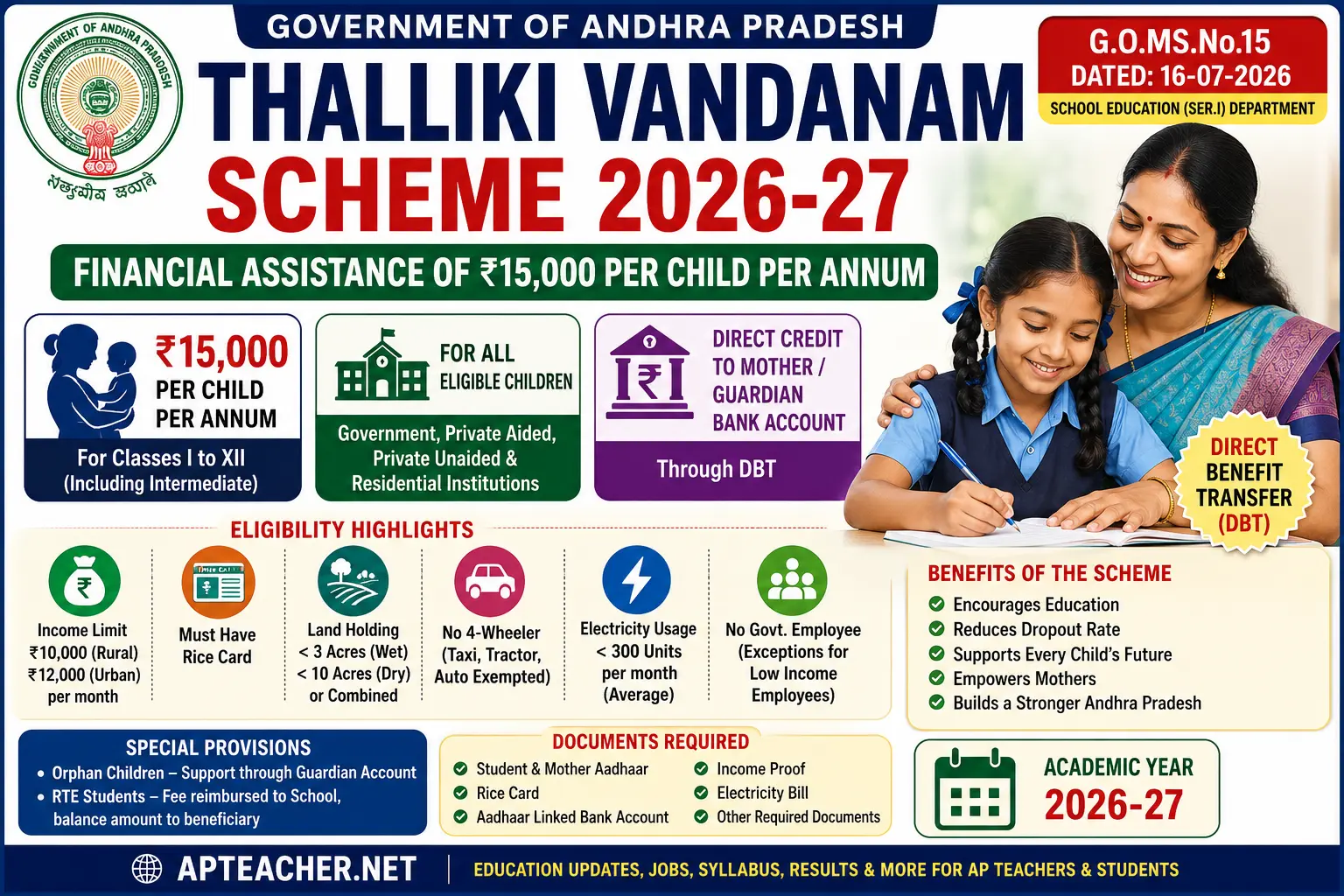
The scheme covers students studying from Class I to Class XII (Intermediate) in recognized Government, Private Aided, Private Unaided and Residential Schools/Junior Colleges across Andhra Pradesh. Unlike many welfare programmes, the financial assistance is provided for every eligible child in the family, irrespective of the number of children, subject to the prescribed eligibility conditions.
Download GO.15 Talliki Vandanam PDF
The Andhra Pradesh Government introduced this initiative to reduce the financial burden on families, improve enrolment and retention of students, increase parental participation in education, and ensure that every child receives uninterrupted quality education. Under the 2026-27 guidelines, the Government has retained the key features of the scheme while issuing detailed implementation procedures, eligibility criteria, verification mechanisms, grievance redressal process and Direct Benefit Transfer (DBT) guidelines. :contentReference[oaicite:0]{index=0}
Table of Contents
- Scheme Overview
- Key Highlights
- What is Thalliki Vandanam Scheme?
- Objectives of the Scheme
- What’s New in 2026-27?
- ₹15,000 Financial Assistance Explained
- Why ₹2,000 is Deducted?
- Eligibility Criteria
- Required Documents
- DBT Payment Process
- Frequently Asked Questions
Thalliki Vandanam Scheme 2026-27 Overview
| Particular | Details |
|---|---|
| Scheme Name | Thalliki Vandanam Scheme |
| State | Andhra Pradesh |
| Academic Year | 2026-27 |
| Government Order | G.O.Ms.No.15, School Education (Ser.I), Dated 16-07-2026 |
| Financial Assistance | ₹15,000 per child per annum |
| Mode of Payment | Direct Benefit Transfer (DBT) |
| Beneficiary | Eligible Mother/Guardian |
| Applicable Classes | Class I to Class XII (Intermediate) |
| Eligible Institutions | Government, Private Aided, Private Unaided & Residential Schools/Junior Colleges |
| Official Department | School Education Department, Government of Andhra Pradesh |
Key Highlights of Thalliki Vandanam Scheme 2026-27
- Financial assistance of ₹15,000 per child every year.
- Benefit available for every eligible child in a family without any restriction on the number of children.
- Applicable to students studying from Class I to Class XII (Intermediate).
- Funds will be transferred directly to the Aadhaar-linked bank account of the eligible mother or guardian.
- Government, Private Aided, Private Unaided and Residential educational institutions are covered.
- Special provisions have been made for orphan children and students admitted under the Right to Education Act.
- Comprehensive Aadhaar verification, NPCI mapping and household verification will be conducted before releasing funds.
- The scheme focuses on increasing enrolment, reducing dropouts and improving learning outcomes across Andhra Pradesh.
What is Thalliki Vandanam Scheme?
The Thalliki Vandanam Scheme is one of the flagship educational welfare initiatives launched by the Government of Andhra Pradesh to encourage every child to continue school education without financial hardship. Recognising the important role played by mothers in shaping the educational future of children, the Government provides annual financial support directly to eligible mothers or guardians.
Unlike traditional scholarship programmes that are limited to selected categories of students, the Thalliki Vandanam Scheme has a broader objective of strengthening school education by empowering families financially. The scheme supports children studying in recognized schools and junior colleges from Class I to Intermediate, ensuring that economic difficulties do not become a barrier to education.
The financial assistance received under the scheme can be utilized for various educational needs such as purchasing textbooks, uniforms, notebooks, school bags, footwear, transportation, examination fees, digital learning resources and other educational expenses incurred during the academic year.
The Government believes that when mothers are financially empowered, they become active partners in ensuring regular attendance, better academic performance and overall development of their children. This approach also strengthens the relationship between schools, parents and the education system.
Objectives of the Thalliki Vandanam Scheme
The Andhra Pradesh Government introduced the Thalliki Vandanam Scheme with several long-term educational and social objectives. The scheme is not merely a financial assistance programme but a comprehensive initiative aimed at improving educational outcomes throughout the State.
- Ensure that every child has equal access to quality school education.
- Reduce the financial burden on economically weaker families.
- Empower mothers by directly transferring educational assistance into their bank accounts.
- Improve enrolment in Government and recognized schools.
- Reduce student dropout rates.
- Increase regular attendance among school children.
- Promote continuity of education from primary to higher secondary level.
- Strengthen parental participation in children’s education.
- Improve literacy and educational outcomes across Andhra Pradesh.
- Create an inclusive education ecosystem benefiting students from all eligible communities.
What’s New in Thalliki Vandanam Scheme 2026-27?
For the Academic Year 2026-27, the Government has continued the successful implementation of the scheme with updated operational guidelines. Several important implementation measures have been introduced to improve transparency, accountability and timely payment of financial assistance.
- The scheme continues with ₹15,000 annual assistance per eligible child.
- Comprehensive Aadhaar verification will be carried out for both students and mothers/guardians.
- Mother-child mapping has been made mandatory for accurate beneficiary identification.
- NPCI-linked Aadhaar seeded bank accounts will be compulsory for DBT payments.
- Data verification will be conducted using Household Survey and Civil Supplies databases.
- Additional admissions in Classes I and XI up to the notified cut-off date will also be considered.
- Online grievance redressal mechanism has been strengthened for quicker resolution of beneficiary issues.
- Beneficiary lists will be displayed publicly for transparency and social audit.
These improvements are expected to ensure faster implementation, minimize errors, prevent duplicate claims and enable timely transfer of benefits to eligible families throughout Andhra Pradesh.
Thalliki Vandanam Scheme 2026-27 Eligibility Criteria
To ensure that the benefits of the Thalliki Vandanam Scheme 2026-27 reach genuinely deserving families, the Government of Andhra Pradesh has prescribed detailed eligibility conditions. Every application will undergo multiple levels of verification through Aadhaar authentication, household survey records, Civil Supplies database, and other Government databases before the financial assistance is sanctioned. :contentReference[oaicite:0]{index=0}
Only those families satisfying all prescribed conditions will receive financial assistance under the scheme. Parents are therefore advised to verify their eligibility before expecting the benefit.
1. Income Eligibility
The annual financial assistance is intended for economically weaker families. Therefore, the monthly household income should not exceed the following limits:
| Area | Maximum Monthly Income |
|---|---|
| Rural Areas | ₹10,000 |
| Urban Areas | ₹12,000 |
If the household income exceeds these prescribed limits, the family will not be eligible for benefits under the Thalliki Vandanam Scheme.
2. Rice Card Requirement
At least one member of the family should possess a valid Rice Card. The Rice Card serves as one of the important indicators for identifying eligible households under various welfare schemes of the Andhra Pradesh Government.
Families without a valid Rice Card may not qualify unless otherwise permitted under Government guidelines.
3. Agricultural Land Limits
The total agricultural land owned by the household should not exceed the prescribed limits.
| Type of Land | Maximum Permissible Holding |
|---|---|
| Wet Land | Less than 3 Acres |
| Dry Land | Less than 10 Acres |
| Combined Wet & Dry Land | Less than 10 Acres |
Land ownership details will be verified through Government records during beneficiary verification.
4. Four-Wheeler Ownership
Families owning a private four-wheeler are generally not eligible for the scheme.
However, the following vehicles are exempted:
- Taxi Vehicles
- Auto Rickshaws
- Tractors
These vehicles are treated as livelihood assets and therefore will not affect eligibility.
5. Electricity Consumption Limit
The Government has prescribed an electricity consumption limit to identify economically weaker households.
The household’s average electricity consumption during the previous 12 months should be less than:
300 Units Per Month
The average annual consumption will be considered instead of a single month’s bill.
6. Municipal Property Condition
The household should not own municipal property measuring:
1000 Square Feet or More
Ownership details will be verified through municipal databases wherever applicable.
7. Government Employee Restriction
The household will generally become ineligible if any member is:
- Central Government Employee
- State Government Employee
- PSU Employee
- Government Pensioner
Exceptions:
- Anganwadi Workers
- Sanitation Workers
- Employees earning below ₹10,000 per month in Rural Areas
- Employees earning below ₹12,000 per month in Urban Areas
8. Income Tax Payers
If any member of the household is an Income Tax payer, the family will not be eligible for financial assistance under the scheme.
9. Andhra Pradesh Household Database
The beneficiary must be included in the official Household Database maintained by the Government of Andhra Pradesh.
If the child is present in the database but the mother or guardian is missing, field verification will be conducted before approving the application.
Eligible Students Under the Scheme
Students studying in the following institutions are eligible, subject to fulfillment of all eligibility conditions:
- Government Schools
- Government Junior Colleges
- Private Aided Schools
- Private Aided Junior Colleges
- Private Unaided Recognized Schools
- Private Unaided Recognized Junior Colleges
- Residential Schools
- Residential Junior Colleges
The institution must be recognized by the Government of Andhra Pradesh.
Students Who Are Not Eligible
The following students are excluded from the Thalliki Vandanam Scheme:
- Students studying in ITI institutions.
- Students pursuing Polytechnic courses.
- Students studying in IIIT (RGUKT).
- Students receiving similar benefits through fee reimbursement schemes notified by the Government.
- Students studying in institutions not recognized by the Government.
Special Provisions for Orphan Children
The Government has made special arrangements to ensure that orphan children also receive financial assistance.
- Eligible orphan children studying in recognized schools can receive benefits.
- If the child does not have a bank account, the District Collector will facilitate opening a Guardian-operated Minor Savings Bank Account.
- Financial assistance will be released after due verification by the competent authorities.
Eligibility of Students Admitted Under RTE Act
Children admitted in Private Unaided Schools under Section 12(1)(c) of the Right to Education (RTE) Act, 2009 are also covered under the scheme.
The Government will reimburse the prescribed school fee directly to the school management through Samagra Shiksha. Any remaining balance amount, if applicable, will be credited to the beneficiary’s Aadhaar-linked bank account.
Documents Required for Thalliki Vandanam Scheme 2026-27
Beneficiaries should keep the following documents ready to avoid delays during verification and DBT processing:
- Student Aadhaar Card
- Mother’s Aadhaar Card
- Guardian Aadhaar (if applicable)
- Rice Card
- Aadhaar-linked Bank Passbook
- Mobile Number linked with Aadhaar
- School Admission Details
- UDISE Student Record
- Income Details
- Electricity Consumer Number
- Land Records (where applicable)
Aadhaar Verification & Mother-Child Mapping
One of the major improvements introduced in the 2026-27 implementation is the comprehensive verification process. The Government will authenticate:
- Student Aadhaar Number
- Mother’s Aadhaar Number
- Relationship between Mother and Child
- Duplicate Records
- Invalid Aadhaar Entries
- Household Survey Records
- Civil Supplies Database
- NPCI Aadhaar Seeding Status
Only verified beneficiaries will become eligible for Direct Benefit Transfer (DBT), ensuring transparency and preventing duplicate or fraudulent claims.
₹15,000 Financial Assistance Under Thalliki Vandanam Scheme 2026-27
One of the biggest attractions of the Thalliki Vandanam Scheme 2026-27 is the annual financial assistance of ₹15,000 per eligible child. Unlike many scholarship schemes that limit benefits to only one child in a family, the Andhra Pradesh Government has clearly stated that the benefit is available for every eligible child, irrespective of the number of children in the family, provided all eligibility conditions are satisfied. :contentReference[oaicite:0]{index=0}
The financial assistance is designed to reduce the educational expenses borne by parents and encourage them to continue their children’s education without interruption. Since the amount is transferred directly to the beneficiary’s Aadhaar-linked bank account through the Direct Benefit Transfer (DBT) system, the process is transparent, efficient, and minimizes delays.
How Can Families Use the ₹15,000 Assistance?
Although the Government does not prescribe mandatory spending categories, the assistance is intended to support various educational expenses incurred throughout the academic year.
- Purchase of school uniforms
- Textbooks and notebooks
- School bags and stationery
- Footwear and educational materials
- Digital learning devices and internet expenses
- Transportation costs
- Examination fees
- School projects and practical materials
- Private tuition, where necessary
- Other educational expenses of the child
By reducing the financial burden on families, the Government expects better school attendance, improved learning outcomes, and lower dropout rates across Andhra Pradesh.
Why is ₹2,000 Deducted from the Scheme Amount?
An important feature introduced under the scheme is the deduction of ₹2,000 per student from the sanctioned assistance amount. This deduction is not a penalty or reduction in benefits; instead, it is an investment in improving the educational environment of schools and junior colleges across the State. :contentReference[oaicite:1]{index=1}
The deducted amount will be utilized for strengthening the educational ecosystem, including:
- School maintenance and repairs
- Campus cleanliness
- Hygiene and sanitation
- Improvement of school infrastructure
- Student-friendly learning environment
- Other purposes specified by the School Education Department through Standard Operating Procedures (SOPs)
This initiative ensures that while individual students receive financial assistance, schools also benefit from improved infrastructure and facilities, creating a better learning atmosphere for all students.
Illustration of Financial Assistance
| Particular | Amount |
|---|---|
| Annual Assistance per Eligible Child | ₹15,000 |
| Amount Deducted for Educational Ecosystem | ₹2,000 |
| Balance Amount Paid to Beneficiary (Subject to Applicable Rules) | As per Government Guidelines |
Direct Benefit Transfer (DBT) Payment Process
The Andhra Pradesh Government has adopted the Direct Benefit Transfer (DBT) mechanism to ensure that financial assistance reaches eligible beneficiaries without intermediaries.
The payment process is designed to eliminate delays, prevent duplication, and improve transparency in welfare delivery.
Step 1: Student Data Collection
Schools and Junior Colleges collect student information through UDISE and official departmental portals. This includes personal details, Aadhaar information, class, institution details, and parent or guardian information.
Step 2: Verification of Beneficiary Details
The submitted information undergoes verification through multiple Government databases to confirm:
- Student Aadhaar authentication
- Mother or Guardian Aadhaar authentication
- Household details
- Rice Card information
- Income eligibility
- Land ownership records
- Electricity consumption
- Government employment status
- Income Tax records
Step 3: Aadhaar Seeding Verification
Before releasing the amount, the beneficiary’s bank account must be linked with Aadhaar through the NPCI (National Payments Corporation of India). If Aadhaar seeding is incomplete, the DBT transaction may fail.
Step 4: Approval of Beneficiary List
After successful verification, the final list of eligible beneficiaries is prepared and shared with the Welfare Departments for sanction and payment.
Step 5: Fund Transfer
The approved amount is credited directly into the Aadhaar-linked bank account of the eligible mother or guardian through DBT.
Mode of Payment Under the Scheme
The Government has prescribed a clear order of priority for releasing financial assistance.
| Situation | Payment Made To |
|---|---|
| Both Parents Available | Mother’s Aadhaar-linked Bank Account |
| Single Parent Family | Father’s Aadhaar-linked Bank Account |
| Both Parents Not Available | Guardian’s Aadhaar-linked Bank Account |
| Orphan Children | District Collector for verification and onward disbursement |
Payment to Students Admitted Under RTE Act, 2009
Students admitted to Private Unaided Schools under Section 12(1)(c) of the Right to Education Act, 2009 receive special treatment under the scheme.
In such cases:
- The Government-approved fee is reimbursed directly to the Private School Management.
- The payment is routed through the State Project Director, Samagra Shiksha.
- If any balance amount remains after payment of school fees, it will be transferred to the beneficiary’s Aadhaar-linked bank account.
Role of APCFSS in Thalliki Vandanam Scheme
The Andhra Pradesh Centre for Financial Systems and Services (APCFSS) plays a crucial role in implementing the DBT payment system.
Its responsibilities include:
- Creating NPCI payment codes.
- Managing electronic fund transfers.
- Ensuring secure and transparent transactions.
- Supporting Aadhaar-enabled DBT payments.
- Coordinating with Finance and Welfare Departments.
Role of Welfare Departments
Several Welfare Departments jointly implement the Thalliki Vandanam Scheme to ensure that eligible beneficiaries from different communities receive assistance.
These include:
- Social Welfare Department
- Backward Classes Welfare Department
- Tribal Welfare Department
- Minority Welfare Department
- EWS Welfare Department
- Women Development, Child Welfare & Disabled Welfare Department
These departments issue sanction orders, verify beneficiary lists, and release funds according to Government guidelines.
Role of Samagra Shiksha
The State Project Director, Samagra Shiksha, is responsible for managing reimbursements related to students admitted in Private Unaided Schools under the Right to Education (RTE) Act.
Samagra Shiksha receives the reimbursement amount from the Welfare Departments and transfers the approved fee to the respective private school managements in accordance with Government norms.
Display of Beneficiary List
To maintain transparency and encourage public participation, the final list of eligible beneficiaries will be displayed at:
- Swarna Gramam Offices
- Swarna Ward Offices
- Other designated Government offices
This public display facilitates social audit and enables citizens to report any discrepancies or irregularities in the beneficiary selection process.
Warning Against Fraudulent Claims
The Government has issued a strict warning against furnishing false information to obtain benefits under the Thalliki Vandanam Scheme.
If any person is found submitting fake or misleading information, the Government may:
- Cancel the financial assistance.
- Recover the amount already paid.
- Initiate criminal proceedings against the individuals responsible.
Applicants should therefore ensure that all information submitted during registration and verification is genuine and supported by valid documents.
Implementation Process of Thalliki Vandanam Scheme 2026-27
The Government of Andhra Pradesh has designed a comprehensive implementation mechanism to ensure that the financial assistance reaches every eligible beneficiary in a transparent, efficient and accountable manner. Multiple departments work together by integrating school records, Aadhaar authentication, welfare databases and banking systems before releasing the assistance under the Thalliki Vandanam Scheme 2026-27. :contentReference[oaicite:0]{index=0}
The implementation process has been structured to eliminate duplicate records, prevent fraudulent claims and ensure that only genuine beneficiaries receive the assistance.
Step-by-Step Implementation Process
Step 1: Student Data Collection
The first stage begins at the school level. Every recognized Government, Private Aided, Private Unaided and Residential School/Junior College is responsible for updating accurate student information through the official education portals.
The information collected includes:
- Student Name
- Aadhaar Number
- Date of Birth
- Gender
- Class Studying
- School Name
- Caste and Sub-Caste
- Mother/Guardian Details
- Relationship with Student
Step 2: Verification of School Data
The Headmaster or Principal must ensure that all student information uploaded in UDISE and departmental portals is correct and updated. Any incorrect or incomplete information may delay or reject the beneficiary’s application.
Parents are therefore advised to verify their child’s Aadhaar details, bank account details and admission records with the school well before the verification process begins.
Step 3: Aadhaar Authentication
The School Education Department, SGSW Department and APCFSS jointly verify:
- Student Aadhaar Number
- Mother’s Aadhaar Number
- Guardian Aadhaar (where applicable)
- Mother-Child Relationship Mapping
- Duplicate Beneficiary Records
Only authenticated records proceed to the next stage of verification.
Step 4: Household Verification
The beneficiary details are matched with multiple Government databases including:
- Household Survey Database
- Civil Supplies Department
- Rice Card Database
- Land Records
- Electricity Department
- Income Records
- Government Employee Database
- Income Tax Database
This multi-layer verification ensures that only eligible households receive the scheme benefits.
Step 5: Beneficiary Approval
After successful verification, the SGSW Department prepares the final beneficiary list and forwards it to the concerned Welfare Departments for administrative sanction.
The approved list is also displayed publicly for social audit and transparency.
Role of Various Departments
Implementation of the scheme involves coordination among several Government departments. Each department has clearly defined responsibilities.
| Department | Primary Responsibility |
|---|---|
| School Education Department | Student data collection and monitoring |
| Director of Intermediate Education | Junior College student data |
| SGSW Department | Eligibility verification |
| Finance Department | Release of funds |
| APCFSS | DBT and NPCI payment processing |
| Samagra Shiksha | RTE reimbursement management |
| District Collectors | District-level implementation and monitoring |
Responsibilities of Schools
Schools play a vital role in the successful implementation of the scheme. They are responsible for maintaining accurate student records and assisting parents throughout the verification process.
Schools should:
- Update UDISE information regularly.
- Verify Aadhaar details of students.
- Ensure mother/guardian information is correct.
- Correct any discrepancies immediately.
- Guide parents regarding eligibility and documentation.
- Coordinate with education department officials.
Responsibilities of Parents
Parents and guardians also have important responsibilities to ensure smooth processing of their applications.
- Provide correct Aadhaar details.
- Maintain an Aadhaar-seeded bank account.
- Ensure Rice Card information is updated.
- Inform schools about any change in personal details.
- Submit documents whenever requested.
- Avoid providing false information.
Grievance Redressal Mechanism
The Government has established a transparent grievance redressal system to help beneficiaries resolve issues related to eligibility, Aadhaar verification, payment delays and beneficiary status.
If an eligible family is excluded from the beneficiary list or if payment is delayed, they may submit their grievance through the designated mechanism.
Where Can Beneficiaries Register Complaints?
- Swarna Gramam Offices
- Swarna Ward Offices
- Online Grievance Portal
- Concerned Education Officials
- District Administration
All grievances will be monitored through online dashboards to ensure timely disposal.
Important Dates for Academic Year 2026-27
| Event | Date |
|---|---|
| Government Order Issued | 16 July 2026 |
| Scheme Applicable | Academic Year 2026-27 |
| Additional Admissions Considered (Classes I & XI) | Up to 25 August 2026 |
Major Benefits of Thalliki Vandanam Scheme
The scheme offers several educational and social benefits beyond financial assistance.
- Reduces financial burden on families.
- Encourages parents to continue children’s education.
- Improves school enrolment.
- Reduces dropout rates.
- Strengthens girls’ education.
- Promotes regular school attendance.
- Encourages parental involvement.
- Supports economically weaker families.
- Improves learning outcomes.
- Promotes equitable access to education.
Important Tips for Beneficiaries
Parents can avoid delays by following these simple precautions:
- Ensure Aadhaar is linked with your bank account.
- Update your mobile number with Aadhaar.
- Verify school records before submission.
- Maintain an active bank account.
- Check NPCI mapping status.
- Keep copies of all important documents.
- Respond promptly if the school requests corrections.
- Monitor official announcements issued by the School Education Department.
Why This Scheme is Important for Andhra Pradesh
Education is one of the strongest foundations for social and economic development. Through the Thalliki Vandanam Scheme, the Andhra Pradesh Government aims to remove financial barriers that prevent children from completing their education.
By directly empowering mothers and guardians, the Government expects higher enrolment, improved attendance, better academic performance and stronger community participation in school education. The initiative also complements other educational reforms aimed at improving infrastructure, digital learning and overall educational quality in the State.