AP Presidential Order 2025 Draft Guidelines on Employee Allocation Released – Complete Details, Committees & Allocation Process
The Government of Andhra Pradesh has released the Draft Guidelines regarding Allocation of Employees under the Andhra Pradesh Public Employment (Organisation of Local Cadres and Regulation of Direct Recruitment) Order, 2025. The draft guidelines explain the complete procedure for allocating Government employees into newly constituted District, Contiguous District, Zonal, Contiguous Zonal and Multi-Zonal Cadres following the implementation of the Presidential Order 2025. These draft guidelines are expected to play a crucial role in reorganizing Government employees after the formation of new local cadres under the Presidential Order. The document explains the constitution of Implementation Committees, preparation of seniority lists, employee options, allotment procedure, special category preferences, spouse cases, representation mechanism and issue of allotment orders.
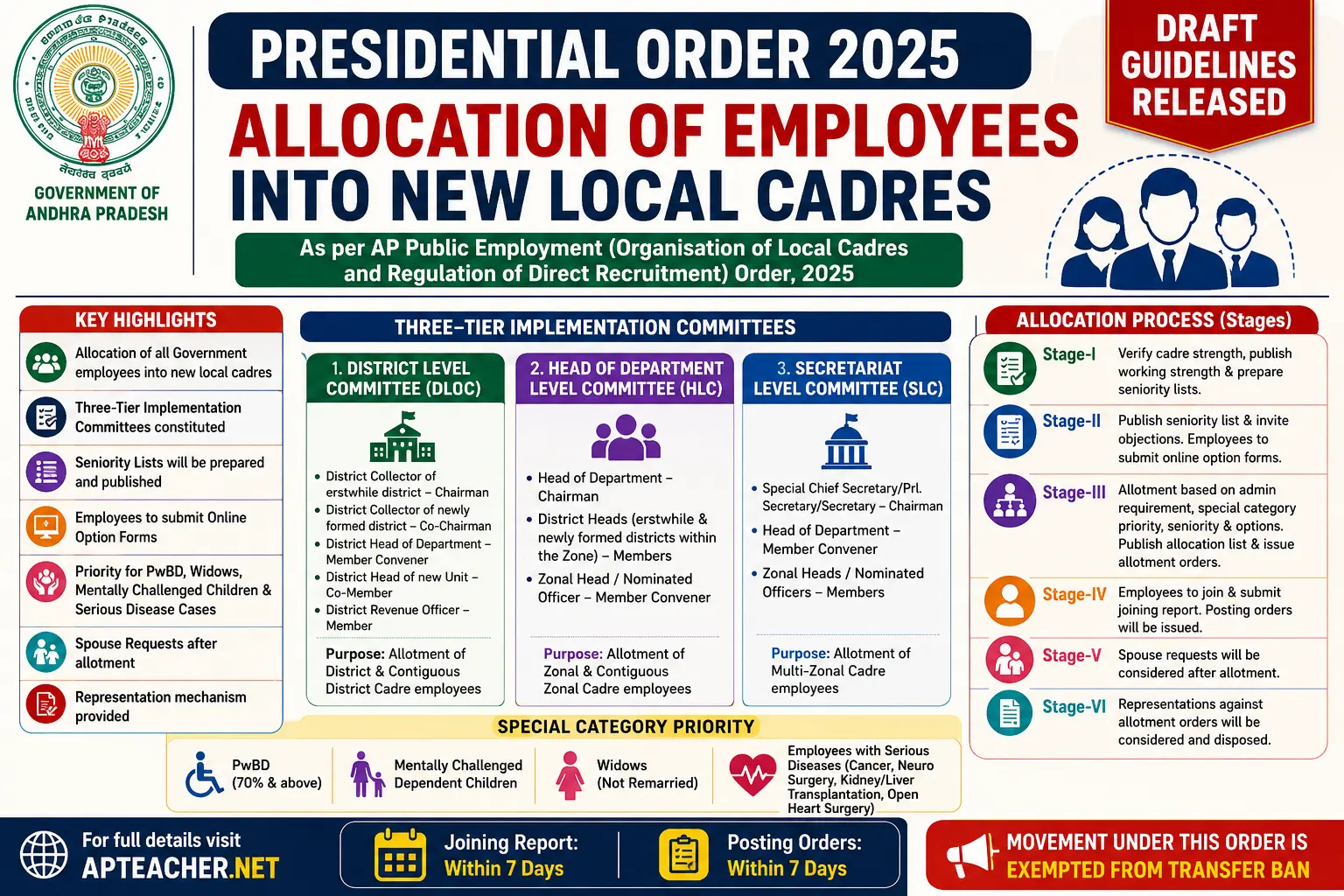
Table of Contents
- Overview
- Background
- Key Highlights
- Three-Tier Implementation Committees
- District Level Committee
- Head of Department Committee
- Secretariat Level Committee
- What Happens Next?
Overview
| Document | Draft Guidelines for Allocation of Employees under Presidential Order 2025 |
|---|---|
| Issued By | Government of Andhra Pradesh |
| Applicable To | All Government Departments |
| Based On | AP Public Employment (Organisation of Local Cadres and Regulation of Direct Recruitment) Order, 2025 |
| Purpose | Allocation of Employees into New Local Cadres |
| Status | Draft Guidelines |
Background
The Andhra Pradesh Government republished the Presidential Order, 2025 through G.O.Ms.No.45, General Administration (SPF & MC) Department dated 20-04-2026. The Presidential Order came into force with effect from 15 December 2025. Subsequently, through G.O.Ms.No.54 dated 14-05-2026, the Government organized civil posts into different local cadres including District Cadres, Contiguous District Cadres, Zonal Cadres, Contiguous Zonal Cadres and Multi-Zonal Cadres. After determining cadre strength and distribution of posts, the Government has now issued Draft Guidelines explaining how employees will be allotted to the newly constituted local cadres.
Major Highlights of Draft Guidelines
- Allocation of all Government employees under Presidential Order 2025.
- Formation of new District, Zonal and Multi-Zonal cadres.
- Constitution of three-level Implementation Committees.
- Preparation and publication of seniority lists.
- Employees will submit online option forms.
- Special priority for PwBD employees, widows, employees having mentally challenged children and employees suffering from serious diseases.
- Provision for spouse requests after allotment.
- Opportunity to submit representations against allotment orders.
Three-Tier Implementation Committees
To ensure smooth implementation of employee allocation, the Government has constituted three different committees at various administrative levels.
| Committee | Purpose |
|---|---|
| District Level Committee (DLC) | Allocation of District Cadre & Contiguous District Cadre employees. |
| Head of Department Level Committee (HLC) | Allocation of Zonal & Contiguous Zonal Cadre employees. |
| Secretariat Level Committee (SLC) | Allocation of Multi-Zonal Cadre employees. |
1. District Level Committee (DLC)
The District Level Committee is responsible for allotting employees belonging to District Cadres and Contiguous District Cadres.
Composition
- District Collector of the erstwhile district – Chairman
- District Collector of the newly formed district – Co-Chairman
- District Head of the Department – Member Convener
- District Head of the New Unit – Co-Member
- District Revenue Officer – Member
Purpose: Allocation of employees to newly constituted District and Contiguous District Cadres.
2. Head of Department Level Committee (HLC)
The Head of Department Committee will supervise allotment of employees working under Zonal and Contiguous Zonal Cadres.
Composition
- Head of Department – Chairman
- District Heads of erstwhile and newly formed districts – Members
- Zonal Head / Nominated Officer – Member Convener
Purpose: Allocation of employees to Zonal and Contiguous Zonal Cadres.
3. Secretariat Level Committee (SLC)
The Secretariat Level Committee will deal with employees belonging to Multi-Zonal Cadres.
Composition
- Special Chief Secretary / Principal Secretary / Secretary – Chairman
- Head of Department – Member Convener
- Zonal Heads or nominated officers – Members
Purpose: Allocation of employees to newly constituted Multi-Zonal Cadres.
What Happens Next?
After constituting the committees, the Government has prescribed a detailed six-stage procedure for employee allocation. The process includes verification of cadre strength, preparation of seniority lists, inviting employee options, allotment based on seniority and special categories, issue of allotment orders, spouse requests and disposal of representations.
Stage-I: Verification of Cadre Strength & Preparation of Seniority Lists
Stage-III is the most important phase of the Draft Guidelines. During this stage, the Implementation Committees will allot Government employees to the newly constituted District, Contiguous District, Zonal, Contiguous Zonal and Multi-Zonal Cadres based on administrative requirements, seniority, employee preferences and special category claims.
Principles for Employee Allotment
The Implementation Committee shall ensure that no employee is left unallotted. Employee allocation will be carried out according to the following principles.
- Administrative requirement of each local cadre.
- Cadre strength approved by the Government.
- Employee seniority.
- Employee option preferences.
- Special category claims.
- Reservation norms for SC/ST employees.
Priority in Employee Allotment
Employees belonging to specified special categories shall receive priority in allotment, irrespective of their position in the seniority list, subject to verification of supporting documents.
Priority Order
| Priority | Category |
|---|---|
| 1 | Persons with Benchmark Disabilities (PwBD) having 70% or more disability. |
| 2 | Employees having mentally challenged dependent children. |
| 3 | Widows who have not remarried. |
| 4 | Employees suffering from specified serious diseases. |
Medical Grounds Eligible for Priority
The following medical conditions qualify for priority consideration, subject to submission of valid medical certificates.
- Cancer
- Neuro Surgery
- Kidney Transplantation
- Liver Transplantation
- Open Heart Surgery
Equal Eligibility within Special Categories
If two or more employees belong to the same special category and claim the same local cadre, allotment shall be made strictly according to seniority.
Allocation Based on Seniority
After accommodating all eligible special category employees, the remaining employees shall be allotted according to:
- Employee Seniority
- Employee Preferences submitted through the Option Form
- Availability of vacancies in the preferred Local Cadre
When More Employees Prefer the Same Cadre
If the number of employees opting for a particular District, Zone or Multi-Zone exceeds the available vacancies, allotment shall be made strictly based on seniority.
Higher seniority means higher priority for allotment to the preferred Local Cadre.
SC/ST Proportionate Distribution
After completion of allotment, the Government shall review the proportionate distribution of Scheduled Caste (SC) and Scheduled Tribe (ST) employees in every Local Cadre.
Rules for SC/ST Distribution
- SC/ST employees shall be proportionately distributed.
- Cadre-wise reservation balance shall be maintained.
- If a shortfall exists, suitable adjustment will be made.
- The last allotted General Category employee may be replaced by an SC/ST employee wherever required.
- No adjustment will be made if the required SC/ST proportion has already been achieved.
Publication of Allocation List
After completing the allotment process, the Allocation List shall be published for information of all employees.
The Allocation List will contain:
| Employee Information |
|---|
| Employee Name |
| Designation |
| Department |
| Present Working District |
| Date of Birth |
| Gender |
| CFMS ID |
| Community |
| Mobile Number |
| Preferred Local Cadre |
| Special Category Claim |
| Seniority Number |
Issue of Allotment Orders
Based on the approved Allocation List, the competent authority shall issue individual Allotment Orders to every Government employee. The Allotment Order will specify:
- Name of the employee
- Designation
- CFMS ID
- Existing Local Cadre
- Newly Allotted Local Cadre
- District / Zone / Multi-Zone Details
Important Features of Allotment Orders
- Orders take immediate effect.
- Employees become members of the newly allotted Local Cadre.
- Orders shall be entered in the Service Register.
- The new Local Cadres become operational immediately.
Highlights of Stage-III
| Topic | Provision |
|---|---|
| Primary Basis | Administrative Requirement |
| Second Basis | Special Category Priority |
| Third Basis | Employee Seniority |
| Fourth Basis | Employee Preference |
| Reservation | Proportionate SC/ST Distribution |
| Final Output | Publication of Allocation List & Individual Allotment Orders |
Important: The Draft Guidelines clearly state that administrative requirements, seniority, employee preferences and verified special category claims together form the basis for allotting Government employees to the newly constituted Local Cadres under the Presidential Order, 2025.
Stage-IV: Joining Report & Issue of Posting Orders
After the issue of allotment orders, every Government employee shall report to the newly allotted Local Cadre within the prescribed time. The competent authority shall thereafter issue posting orders wherever necessary.
Submission of Joining Report
- Every employee shall submit the joining report within 7 days from the date of receipt of the allotment order.
- Employees allotted to a different Local Cadre shall report before the concerned Head of Office.
- The Appointing Authority shall issue posting orders within 7 days after receiving the joining report.
Employees Continuing in the Same Local Cadre
If an employee is allotted to the same Local Cadre where he/she is presently working, there is no need for a fresh posting order. Such employees shall:
- Continue at their existing place of work.
- Submit a copy of the allotment order to the Head of Office.
- The allotment order shall be recorded in the Service Register.
Recording in Service Register
The allotment orders issued under the Presidential Order 2025 shall be permanently entered in the employee’s Service Register.
Relief from Existing Local Cadre
Employees allotted to a different District, Zone or Multi-Zone shall be relieved immediately from their existing office and directed to join the newly allotted Local Cadre.
Movement of employees under the Presidential Order shall not be treated as a general transfer and is exempted from the transfer ban.
Special Provision for Census & Election Staff
Government employees engaged in:
- Census-2027 Work
- Election Duties
shall be permitted to continue in their present office until completion of such duties or till the transfer ban is lifted, whichever is earlier.
Stage-V: Spouse Cases
After completion of the allotment process, Government employees whose spouses are also working under the State Government may submit requests for spouse adjustment.
Who Can Apply?
- Both husband and wife should be regular Government employees.
- Both should have completed joining in their newly allotted Local Cadres.
- They should have been allotted to different Local Cadres.
How to Apply?
- Applications shall be submitted through the Online Portal.
- The prescribed application format shall be used.
- The request shall be examined by the concerned Implementation Committee.
Conditions for Spouse Adjustment
- Subject to administrative feasibility.
- Availability of vacancies.
- Approval by the competent authority.
- The employee shall be placed below the last regular candidate in the new Local Cadre.
- The employee shall forego earlier seniority.
Stage-VI: Disposal of Employee Representations
Employees aggrieved by the allotment order may submit representations after joining the newly allotted Local Cadre.
Representation Procedure
- Employee shall first join the newly allotted Local Cadre.
- Representation shall be submitted through the Head of Department or District Head.
- The representation shall be addressed to the Secretary to Government.
- The concerned Implementation Committee shall examine the case.
- Government shall pass final orders.
If Another Employee is Affected
If the representation results in modification of another employee’s allotment:
- Notice shall be issued to the affected employee.
- The employee shall be given one month to submit objections.
- Government shall pass final orders after considering all representations.
Timeline for Disposal
| Activity | Time Limit |
|---|---|
| Submission of Joining Report | Within 7 Days |
| Issue of Posting Orders | Within 7 Days |
| Time to Submit Objections (Affected Employee) | 1 Month |
| Government Final Orders | Within 30 Days |
District Mapping under Presidential Order 2025
The Draft Guidelines provide the mapping of the erstwhile 13 Districts to the newly formed 26 Districts for employee allotment.
| Erstwhile District | Eligible New Districts |
|---|---|
| Srikakulam | Srikakulam, Parvathipuram Manyam |
| Vizianagaram | Vizianagaram, Parvathipuram Manyam |
| Visakhapatnam | Visakhapatnam, Anakapalli, Alluri Sitharama Raju |
| East Godavari | Kakinada, Konaseema, East Godavari |
| West Godavari | West Godavari, Eluru |
| Krishna | Krishna, NTR |
| Guntur | Guntur, Palnadu, Bapatla |
| Prakasam | Prakasam, SPSR Nellore (Border Mapping wherever applicable) |
| SPSR Nellore | SPSR Nellore, Tirupati |
| Chittoor | Chittoor, Tirupati, Annamayya |
| YSR Kadapa | YSR Kadapa, Annamayya |
| Kurnool | Kurnool, Nandyal |
| Anantapuramu | Anantapuramu, Sri Sathya Sai |
New Zonal Structure under Presidential Order 2025
| Multi-Zone | Zones Covered |
|---|---|
| Multi-Zone-I | Zone-I, Zone-II & Zone-III |
| Multi-Zone-II | Zone-IV, Zone-V & Zone-VI |
Frequently Asked Questions (FAQs)
When should employees submit their joining report?
Employees must submit the joining report within seven days of receiving the allotment order.
Can employees change their allotted Local Cadre?
Only through the prescribed representation process or spouse adjustment provisions, subject to Government approval.
Who gets priority in allotment?
Persons with Benchmark Disabilities (70% or above), employees with mentally challenged dependent children, widows and employees suffering from specified serious diseases receive priority.
Will seniority be considered?
Yes. After accommodating eligible special category employees, allotment shall be made strictly based on seniority and employee preferences.
Will spouse requests be considered?
Yes. Eligible spouse cases will be considered after completion of the allotment process, subject to vacancies and administrative feasibility.
Conclusion
The Draft Guidelines issued under the Presidential Order 2025 establish a transparent, structured and legally compliant procedure for reorganizing Government employees into the newly constituted Local Cadres. The guidelines ensure fairness through seniority-based allocation, protection for special category employees, provision for spouse cases and a mechanism for submitting representations against allotment orders. Government employees are advised to carefully study the draft guidelines, verify their seniority details, submit option forms correctly and keep supporting documents ready for claiming any special category benefits.
Stay connected with APTeacher.net for the latest updates on Presidential Order 2025, Employee Allocation, Teacher Transfers, Government Orders, School Education News and Service Rules.
The first stage of the employee allocation process focuses on verifying cadre strength, working strength, and preparation of seniority lists before allotment of employees into the newly constituted local cadres.
Verification of Cadre Strength
The Implementation Committees (ICs) shall verify the cadre strength and working strength of every category of posts allotted to the newly constituted District, Contiguous District, Zonal, Contiguous Zonal and Multi-Zonal cadres.
- Verify cadre strength approved by the Finance Department.
- Ensure no sanctioned post is left unaccounted.
- Confirm allocable strength for every local cadre.
- Ensure distribution complies with the Presidential Order, 2025.
Publication of Employee Details
The working strength of employees in every cadre shall be published for transparency.
- Department Official Website
- Notice Boards of Offices
- Department Records
Preparation of Seniority List
The seniority list shall be prepared strictly according to the instructions issued by the General Administration Department. The seniority list shall contain:
| Employee Details | Included |
|---|---|
| Name of Employee | Yes |
| Date of Birth | Yes |
| Gender | Yes |
| Date of Entry into Present Cadre | Yes |
| Community | Yes |
| Mobile Number | Yes |
| Benchmark Disability Status | Yes |
| Special Category Details | Yes |
Employees Included in Seniority List
The seniority list shall include every employee borne on the cadre, including:
- Regular Employees
- Employees on Probation
- Employees on Leave
- Employees on Deputation
- Employees under Training
- Employees under Suspension
- Employees under Unauthorized Absence
Special Categories Identified
The following employees shall be specifically identified in the seniority list.
- Persons with Benchmark Disabilities (PwBD)
- Widows who have not remarried
- Employees having mentally challenged dependent children
- Employees suffering from serious diseases
Serious Medical Conditions
- Cancer
- Neuro Surgery Cases
- Kidney Transplantation
- Liver Transplantation
- Open Heart Surgery
Employees on Deputation
Employees working on deputation shall be considered for allocation by their parent department. The allotment orders will be issued only by the parent department.
False Information
If any employee furnishes false or misleading information, disciplinary action shall be initiated under the Andhra Pradesh Civil Services (CCA) Rules. Officials who certify incorrect information may also face disciplinary action.
Orientation Meeting
Implementation Committees shall conduct orientation meetings with Joint Staff Councils and employee representatives to explain:
- New Local Cadre Structure
- Allocation Procedure
- Employee Rights
- Option Process
- Implementation Schedule
Stage-II: Publication of Seniority List & Employee Option Forms
Once the seniority verification process is completed, the Government will publish the Draft Seniority List and invite objections from employees.
Publication of Draft Seniority List
- Draft Seniority List shall be published on the Department website.
- The list will also be displayed on Office Notice Boards.
- Employees may submit objections within 3 days.
- Objections shall be examined within the next 3 days.
- Final Seniority List shall be published on the 7th day.
Employee Option Forms
Every Government employee shall submit an online Option Form indicating his or her preferred Local Cadre.
Information Required in Option Form
| Required Information |
|---|
| Name |
| Designation |
| CFMS ID |
| Department |
| Present Working Place |
| Date of Birth |
| Date of Joining Service |
| Present Cadre |
| Community |
| Preferred Local Cadres |
| Special Category Claim |
| Supporting Documents |
Important Note
The option exercised by an employee is final and irrevocable. No request for modification or change of option will be entertained after submission.
Key Takeaways
- Cadre strength verification is the first step.
- Seniority lists will be published publicly.
- Every employee must submit an online Option Form.
- Employees can raise objections within 3 days.
- Special category claims require supporting documents.
- Once submitted, employee options cannot be changed.
Stage-III: Employee Allotment Process under Presidential Order 2025
Stage-III is the most important phase of the Draft Guidelines. During this stage, the Implementation Committees will allot Government employees to the newly constituted District, Contiguous District, Zonal, Contiguous Zonal and Multi-Zonal Cadres based on administrative requirements, seniority, employee preferences and special category claims.
Principles for Employee Allotment
The Implementation Committee shall ensure that no employee is left unallotted. Employee allocation will be carried out according to the following principles.
- Administrative requirement of each local cadre.
- Cadre strength approved by the Government.
- Employee seniority.
- Employee option preferences.
- Special category claims.
- Reservation norms for SC/ST employees.
Priority in Employee Allotment
Employees belonging to specified special categories shall receive priority in allotment, irrespective of their position in the seniority list, subject to verification of supporting documents.
Priority Order
| Priority | Category |
|---|---|
| 1 | Persons with Benchmark Disabilities (PwBD) having 70% or more disability. |
| 2 | Employees having mentally challenged dependent children. |
| 3 | Widows who have not remarried. |
| 4 | Employees suffering from specified serious diseases. |
Medical Grounds Eligible for Priority
The following medical conditions qualify for priority consideration, subject to submission of valid medical certificates.
- Cancer
- Neuro Surgery
- Kidney Transplantation
- Liver Transplantation
- Open Heart Surgery
Equal Eligibility within Special Categories
If two or more employees belong to the same special category and claim the same local cadre, allotment shall be made strictly according to seniority.
Allocation Based on Seniority
After accommodating all eligible special category employees, the remaining employees shall be allotted according to:
- Employee Seniority
- Employee Preferences submitted through the Option Form
- Availability of vacancies in the preferred Local Cadre
When More Employees Prefer the Same Cadre
If the number of employees opting for a particular District, Zone or Multi-Zone exceeds the available vacancies, allotment shall be made strictly based on seniority.
Higher seniority means higher priority for allotment to the preferred Local Cadre.
SC/ST Proportionate Distribution
After completion of allotment, the Government shall review the proportionate distribution of Scheduled Caste (SC) and Scheduled Tribe (ST) employees in every Local Cadre.
Rules for SC/ST Distribution
- SC/ST employees shall be proportionately distributed.
- Cadre-wise reservation balance shall be maintained.
- If a shortfall exists, suitable adjustment will be made.
- The last allotted General Category employee may be replaced by an SC/ST employee wherever required.
- No adjustment will be made if the required SC/ST proportion has already been achieved.
Publication of Allocation List
After completing the allotment process, the Allocation List shall be published for information of all employees.
The Allocation List will contain:
| Employee Information |
|---|
| Employee Name |
| Designation |
| Department |
| Present Working District |
| Date of Birth |
| Gender |
| CFMS ID |
| Community |
| Mobile Number |
| Preferred Local Cadre |
| Special Category Claim |
| Seniority Number |
Issue of Allotment Orders
Based on the approved Allocation List, the competent authority shall issue individual Allotment Orders to every Government employee. The Allotment Order will specify:
- Name of the employee
- Designation
- CFMS ID
- Existing Local Cadre
- Newly Allotted Local Cadre
- District / Zone / Multi-Zone Details
Important Features of Allotment Orders
- Orders take immediate effect.
- Employees become members of the newly allotted Local Cadre.
- Orders shall be entered in the Service Register.
- The new Local Cadres become operational immediately.
Highlights of Stage-III
| Topic | Provision |
|---|---|
| Primary Basis | Administrative Requirement |
| Second Basis | Special Category Priority |
| Third Basis | Employee Seniority |
| Fourth Basis | Employee Preference |
| Reservation | Proportionate SC/ST Distribution |
| Final Output | Publication of Allocation List & Individual Allotment Orders |
Important: The Draft Guidelines clearly state that administrative requirements, seniority, employee preferences and verified special category claims together form the basis for allotting Government employees to the newly constituted Local Cadres under the Presidential Order, 2025.
Stage-IV: Joining Report & Issue of Posting Orders
After the issue of allotment orders, every Government employee shall report to the newly allotted Local Cadre within the prescribed time. The competent authority shall thereafter issue posting orders wherever necessary.
Submission of Joining Report
- Every employee shall submit the joining report within 7 days from the date of receipt of the allotment order.
- Employees allotted to a different Local Cadre shall report before the concerned Head of Office.
- The Appointing Authority shall issue posting orders within 7 days after receiving the joining report.
Employees Continuing in the Same Local Cadre
If an employee is allotted to the same Local Cadre where he/she is presently working, there is no need for a fresh posting order. Such employees shall:
- Continue at their existing place of work.
- Submit a copy of the allotment order to the Head of Office.
- The allotment order shall be recorded in the Service Register.
Recording in Service Register
The allotment orders issued under the Presidential Order 2025 shall be permanently entered in the employee’s Service Register.
Relief from Existing Local Cadre
Employees allotted to a different District, Zone or Multi-Zone shall be relieved immediately from their existing office and directed to join the newly allotted Local Cadre.
Movement of employees under the Presidential Order shall not be treated as a general transfer and is exempted from the transfer ban.
Special Provision for Census & Election Staff
Government employees engaged in:
- Census-2027 Work
- Election Duties
shall be permitted to continue in their present office until completion of such duties or till the transfer ban is lifted, whichever is earlier.
Stage-V: Spouse Cases
After completion of the allotment process, Government employees whose spouses are also working under the State Government may submit requests for spouse adjustment.
Who Can Apply?
- Both husband and wife should be regular Government employees.
- Both should have completed joining in their newly allotted Local Cadres.
- They should have been allotted to different Local Cadres.
How to Apply?
- Applications shall be submitted through the Online Portal.
- The prescribed application format shall be used.
- The request shall be examined by the concerned Implementation Committee.
Conditions for Spouse Adjustment
- Subject to administrative feasibility.
- Availability of vacancies.
- Approval by the competent authority.
- The employee shall be placed below the last regular candidate in the new Local Cadre.
- The employee shall forego earlier seniority.
Stage-VI: Disposal of Employee Representations
Employees aggrieved by the allotment order may submit representations after joining the newly allotted Local Cadre.
Representation Procedure
- Employee shall first join the newly allotted Local Cadre.
- Representation shall be submitted through the Head of Department or District Head.
- The representation shall be addressed to the Secretary to Government.
- The concerned Implementation Committee shall examine the case.
- Government shall pass final orders.
If Another Employee is Affected
If the representation results in modification of another employee’s allotment:
- Notice shall be issued to the affected employee.
- The employee shall be given one month to submit objections.
- Government shall pass final orders after considering all representations.
Timeline for Disposal
| Activity | Time Limit |
|---|---|
| Submission of Joining Report | Within 7 Days |
| Issue of Posting Orders | Within 7 Days |
| Time to Submit Objections (Affected Employee) | 1 Month |
| Government Final Orders | Within 30 Days |
District Mapping under Presidential Order 2025
The Draft Guidelines provide the mapping of the erstwhile 13 Districts to the newly formed 26 Districts for employee allotment.
| Erstwhile District | Eligible New Districts |
|---|---|
| Srikakulam | Srikakulam, Parvathipuram Manyam |
| Vizianagaram | Vizianagaram, Parvathipuram Manyam |
| Visakhapatnam | Visakhapatnam, Anakapalli, Alluri Sitharama Raju |
| East Godavari | Kakinada, Konaseema, East Godavari |
| West Godavari | West Godavari, Eluru |
| Krishna | Krishna, NTR |
| Guntur | Guntur, Palnadu, Bapatla |
| Prakasam | Prakasam, SPSR Nellore (Border Mapping wherever applicable) |
| SPSR Nellore | SPSR Nellore, Tirupati |
| Chittoor | Chittoor, Tirupati, Annamayya |
| YSR Kadapa | YSR Kadapa, Annamayya |
| Kurnool | Kurnool, Nandyal |
| Anantapuramu | Anantapuramu, Sri Sathya Sai |
New Zonal Structure under Presidential Order 2025
| Multi-Zone | Zones Covered |
|---|---|
| Multi-Zone-I | Zone-I, Zone-II & Zone-III |
| Multi-Zone-II | Zone-IV, Zone-V & Zone-VI |
Frequently Asked Questions (FAQs)
When should employees submit their joining report?
Employees must submit the joining report within seven days of receiving the allotment order.
Can employees change their allotted Local Cadre?
Only through the prescribed representation process or spouse adjustment provisions, subject to Government approval.
Who gets priority in allotment?
Persons with Benchmark Disabilities (70% or above), employees with mentally challenged dependent children, widows and employees suffering from specified serious diseases receive priority.
Will seniority be considered?
Yes. After accommodating eligible special category employees, allotment shall be made strictly based on seniority and employee preferences.
Will spouse requests be considered?
Yes. Eligible spouse cases will be considered after completion of the allotment process, subject to vacancies and administrative feasibility.
Conclusion
The Draft Guidelines issued under the Presidential Order 2025 establish a transparent, structured and legally compliant procedure for reorganizing Government employees into the newly constituted Local Cadres. The guidelines ensure fairness through seniority-based allocation, protection for special category employees, provision for spouse cases and a mechanism for submitting representations against allotment orders. Government employees are advised to carefully study the draft guidelines, verify their seniority details, submit option forms correctly and keep supporting documents ready for claiming any special category benefits.
Stay connected with APTeacher.net for the latest updates on Presidential Order 2025, Employee Allocation, Teacher Transfers, Government Orders, School Education News and Service Rules.