Thalliki Vandanam Payment Schedule 2026: ₹13,000 DBT Release Date, Payment Process & Latest Updates
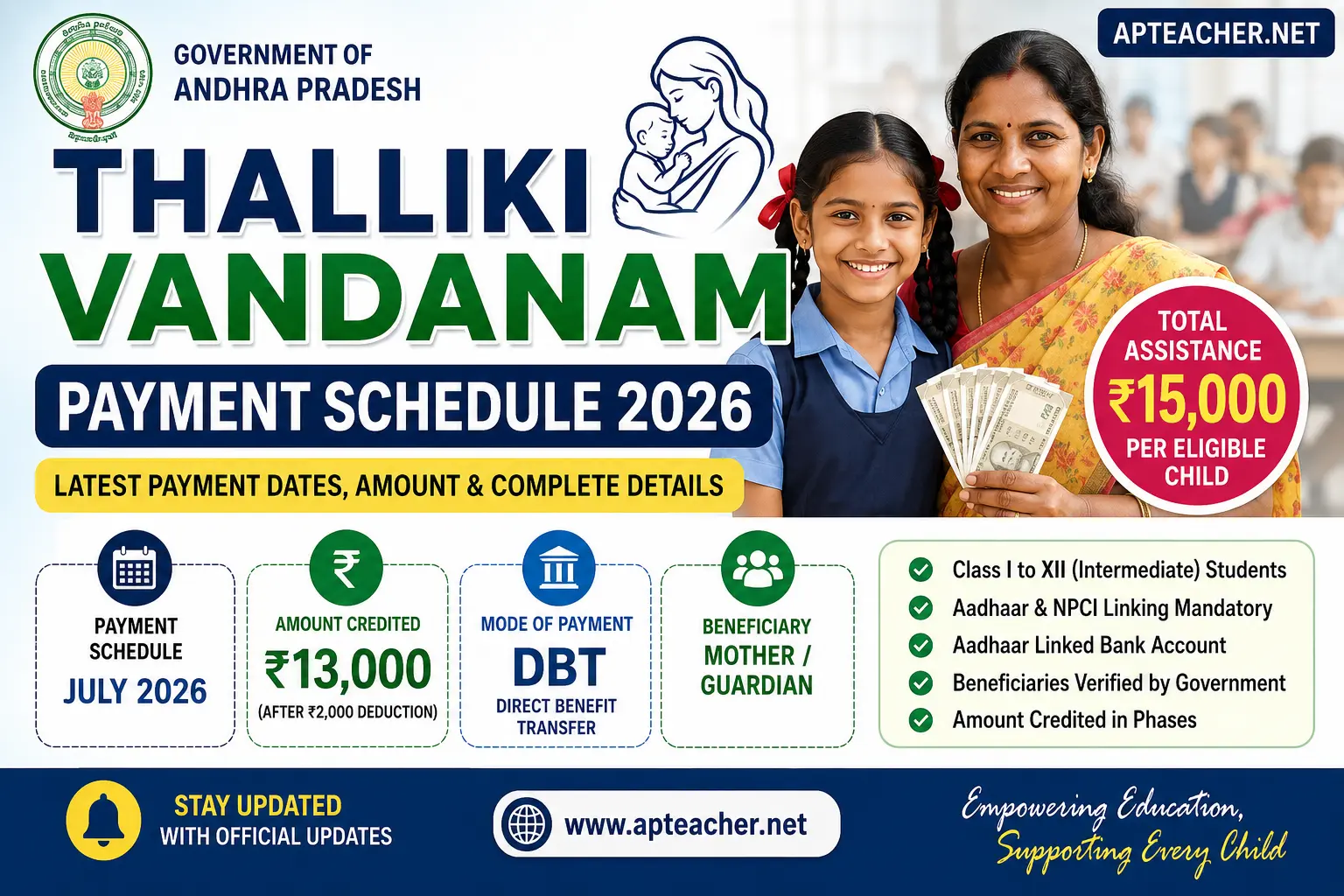
The Government of Andhra Pradesh has started implementing the Thalliki Vandanam Scheme 2026-27, one of its flagship education welfare programmes. Under this scheme, eligible mothers or guardians receive financial assistance to support the education of children studying from Class I to Class XII (Intermediate). The assistance is released through the Direct Benefit Transfer (DBT) system into Aadhaar-linked bank accounts.
- Mega PTM 3.1 Invitation Card Primary Click Here
- Mega PTM 3.1 Invitation Card UP School Click Here
- Mega PTM 3.1 Invitation Card High School Click Here
Many parents are searching for the Thalliki Vandanam Payment Schedule 2026, payment dates, eligibility status and the amount that will actually be credited into their bank accounts. This article explains everything in simple language to help beneficiaries understand the payment process.
Table of Contents
- Scheme Overview
- Payment Schedule 2026
- ₹15,000 vs ₹13,000 Explained
- Who Will Receive the Payment?
- Documents Required
- Aadhaar & NPCI Linking
Thalliki Vandanam Payment Overview
| Particular | Details |
|---|---|
| Scheme Name | Thalliki Vandanam |
| Academic Year | 2026-27 |
| Total Assistance | ₹15,000 Per Eligible Child |
| Amount Credited to Beneficiary | ₹13,000 (after Government-prescribed deduction) |
| Mode of Payment | Direct Benefit Transfer (DBT) |
| Beneficiary | Eligible Mother / Guardian |
| Applicable Classes | Class I to XII (Intermediate) |
Latest Thalliki Vandanam Payment Schedule 2026
According to the latest updates, the Andhra Pradesh Government has announced the rollout of the Thalliki Vandanam payments in July 2026. Reports indicate that the financial assistance is being released in phases through the Direct Benefit Transfer (DBT) system after verification of eligible beneficiaries. :contentReference[oaicite:0]{index=0}
| Activity | Status |
|---|---|
| Beneficiary Verification | Completed for eligible families |
| Aadhaar & NPCI Verification | Mandatory before payment |
| DBT Payment Release | Released in phases |
| Payment Mode | Aadhaar-linked Bank Account |
Parents should note that bank credit may not occur simultaneously for all beneficiaries. The Government generally releases payments in batches, so the credit date can vary depending on verification status and banking processes. :contentReference[oaicite:1]{index=1}
Why Do Beneficiaries Receive ₹13,000 Instead of ₹15,000?
Although the scheme provides financial assistance of ₹15,000 per eligible child, the Government has prescribed that ₹2,000 per student will be utilized for improving the educational ecosystem, including school maintenance, sanitation and infrastructure development. Therefore, the amount credited directly to eligible beneficiaries is generally ₹13,000. :contentReference[oaicite:2]{index=2}
| Particular | Amount |
|---|---|
| Total Scheme Assistance | ₹15,000 |
| Educational Ecosystem Contribution | ₹2,000 |
| Amount Credited through DBT | ₹13,000 |
Who Will Receive the Payment?
The payment will be credited only to eligible beneficiaries whose details have been successfully verified by the Government.
- Mother’s Aadhaar is verified.
- Student Aadhaar is verified.
- Mother and child are correctly mapped.
- The bank account is Aadhaar-seeded.
- NPCI mapping is active.
- The family satisfies all eligibility conditions prescribed by the Government.
Documents Required Before Payment
- Student Aadhaar Card
- Mother’s Aadhaar Card
- Rice Card
- Aadhaar-linked Bank Passbook
- Registered Mobile Number
- School Admission Details
- UDISE Student Record
Importance of Aadhaar & NPCI Linking
One of the most common reasons for delayed or failed DBT payments is the absence of proper Aadhaar and NPCI linkage. Before the Government initiates payment, the beneficiary’s bank account must be linked with Aadhaar and mapped through the National Payments Corporation of India (NPCI). If the linkage is incomplete or inactive, the DBT transaction may fail. :contentReference[oaicite:3]{index=3}
Parents should verify their Aadhaar-bank linkage with their bank well before expecting the payment to avoid unnecessary delays.
How to Check Thalliki Vandanam Payment Status 2026
After the Government releases the payment through the Direct Benefit Transfer (DBT) system, beneficiaries can verify whether the amount has been credited successfully. Since payments are released in phases, some beneficiaries may receive the amount earlier than others.
You can check your payment status using the following methods:
- Official Government Portal (when enabled)
- Village/Ward Secretariat (GSWS)
- School Headmaster or Principal
- Bank Passbook Entry
- SMS Alerts from the Bank
- Net Banking or Mobile Banking App
Payment Status Messages and Their Meaning
| Status | Meaning |
|---|---|
| Payment Success | Amount credited successfully. |
| Under Verification | Beneficiary details are still being verified. |
| Pending NPCI | Aadhaar is not properly linked with the bank account. |
| Bank Rejected | Bank account details need correction. |
| Ineligible | One or more eligibility conditions were not satisfied. |
Common Reasons for Payment Failure
If the payment has not been credited, it may be due to one of the following reasons:
- Aadhaar is not linked with the bank account.
- NPCI mapping is inactive.
- Incorrect Aadhaar number.
- Student details not updated in school records.
- Bank account is inactive or closed.
- Mismatch in mother and child details.
- Income or eligibility conditions not satisfied.
- Duplicate beneficiary records.
- Verification process still pending.
How to Correct Payment Issues
If you do not receive the payment, you should immediately verify your details and contact the concerned authorities.
- Visit your child’s school and verify student details.
- Check whether your Aadhaar number is correct.
- Confirm that your bank account is Aadhaar-seeded.
- Verify NPCI mapping with your bank.
- Update your mobile number if required.
- Visit the Village/Ward Secretariat for assistance.
- Submit any missing documents requested by the authorities.
Role of Schools
Schools play an important role in ensuring timely payment under the Thalliki Vandanam Scheme.
- Update student records in UDISE.
- Verify Aadhaar details.
- Correct errors in student information.
- Assist parents during verification.
- Coordinate with education department officials.
Role of Village/Ward Secretariats (GSWS)
Village and Ward Secretariats help beneficiaries throughout the implementation process.
- Verify beneficiary information.
- Accept grievance applications.
- Guide parents regarding eligibility.
- Support correction of beneficiary records.
- Coordinate with Government departments.
Important Tips for Beneficiaries
- Keep your Aadhaar linked with your bank account.
- Ensure NPCI mapping is active.
- Maintain an active savings account.
- Update your mobile number with the bank.
- Check your passbook regularly.
- Respond immediately if the school requests corrections.
- Avoid relying on unofficial websites or social media rumours.
- Follow only official Government announcements.
Frequently Asked Questions (FAQs)
1. How much money will beneficiaries receive?
Eligible beneficiaries receive financial assistance under the scheme as per the Government guidelines, with the prescribed amount credited through DBT after applicable deductions.
2. Who receives the payment?
The payment is generally credited to the Aadhaar-linked bank account of the eligible mother. In special cases, it may be credited to the father or guardian as per Government rules.
3. Is Aadhaar mandatory?
Yes. Aadhaar authentication of both the student and the beneficiary is mandatory.
4. Is NPCI linking compulsory?
Yes. Aadhaar should be mapped with the beneficiary’s bank account through NPCI for successful DBT.
5. Can students studying in Private Schools receive benefits?
Yes. Eligible students studying in recognized Government, Aided and Private Unaided Schools are covered as per Government guidelines.
6. What if my payment is pending?
Verify your Aadhaar, bank account, NPCI status and school records before approaching the concerned authorities.
7. How can I know whether my payment has been credited?
You can check your bank account, passbook, SMS alerts or visit your Village/Ward Secretariat.
8. Can multiple children receive benefits?
Yes. The scheme provides assistance for every eligible child in the family, subject to eligibility conditions.
9. What should I do if my Aadhaar is not linked?
Visit your bank immediately and complete Aadhaar seeding and NPCI mapping.
10. Where can I submit complaints?
Complaints can be submitted through the Village/Ward Secretariat or the grievance mechanism established by the Government.
Conclusion
The Thalliki Vandanam Payment Schedule 2026 is an important initiative aimed at providing timely financial assistance to eligible families for supporting children’s education. Beneficiaries should ensure that their Aadhaar, bank account, NPCI mapping and school records are updated to avoid delays in receiving the payment.
Parents are advised to follow only official Government notifications regarding payment schedules and eligibility. Keeping documents updated and responding promptly to verification requests will help ensure smooth and timely credit of benefits.