LIP Baseline, Midline & Endline Test Question Papers 2026-27 PDF Download – Complete Evaluation Guidelines
The Learning Improvement Programme (LIP) has been introduced to strengthen foundational learning and continuously monitor students’ academic progress throughout the academic year. Under this programme, students are assessed through Baseline, Midline, and Endline Tests, enabling teachers to identify learning gaps, implement remedial teaching strategies, and improve overall classroom performance.
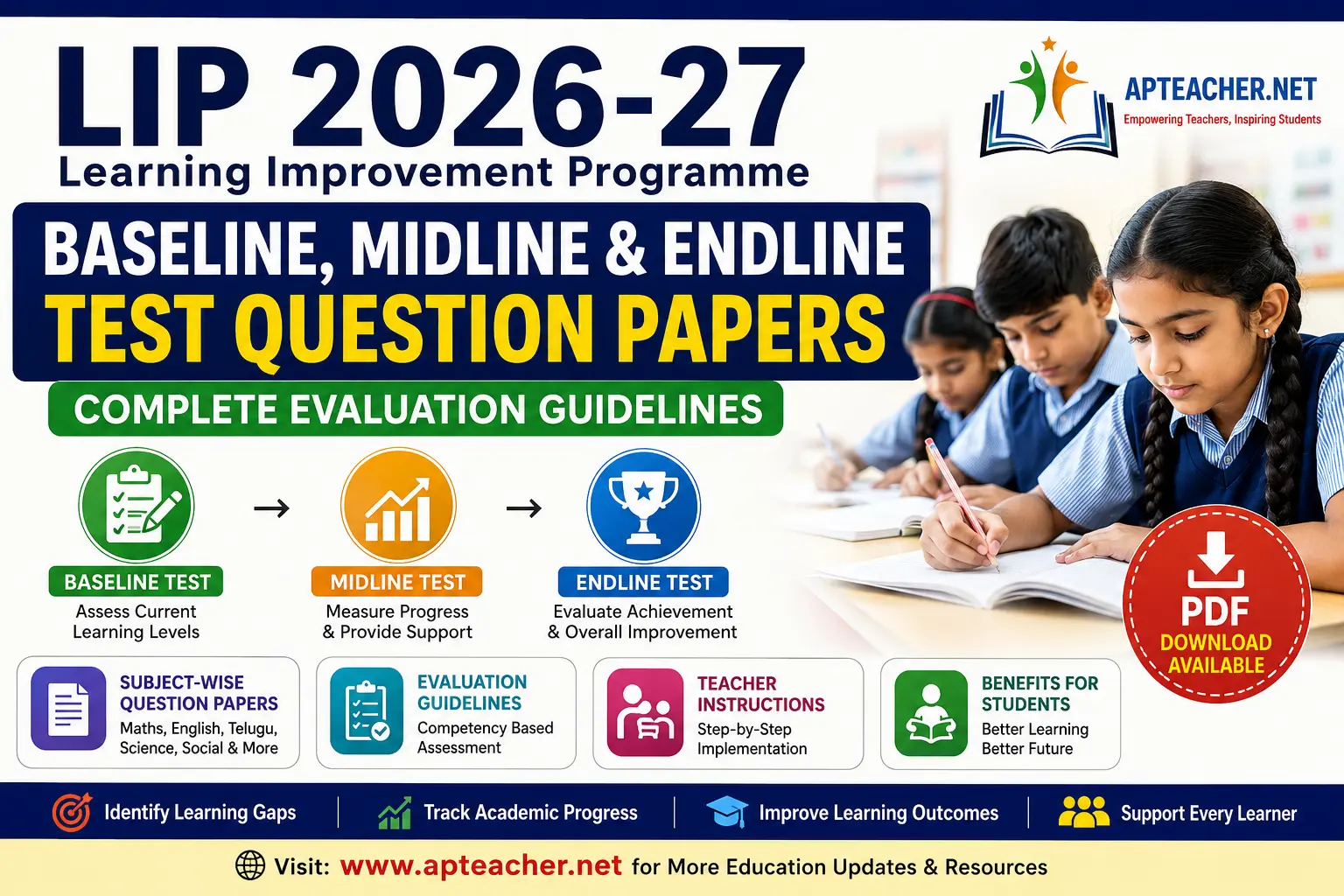
This article provides complete information about LIP Baseline, Midline, and Endline Question Papers 2026-27, including objectives, evaluation guidelines, assessment procedures, implementation process, subject-wise assessment details, and important instructions for teachers. It also includes download links for question papers and official guidelines whenever available.
Table of Contents
- Overview
- What is Learning Improvement Programme (LIP)?
- Objectives of LIP
- Baseline Assessment
- Midline Assessment
- Endline Assessment
- Evaluation Guidelines
- Subjects Covered
LIP 2026-27 Overview
| Particular | Details |
|---|---|
| Programme Name | Learning Improvement Programme (LIP) |
| Academic Year | 2026-27 |
| Assessments | Baseline, Midline & Endline Tests |
| Purpose | Assess student learning progress and improve academic achievement |
| Applicable Classes | Primary & Secondary Schools (as notified) |
| Conducted By | School Education Department, Andhra Pradesh |
| Evaluation | School-level assessment following official evaluation guidelines |
| Question Papers | Subject-wise PDF |
| Official Website | School Education Department, Andhra Pradesh |
What is the Learning Improvement Programme (LIP)?
The Learning Improvement Programme (LIP) is an academic intervention designed to improve student learning outcomes through periodic assessments and structured remedial teaching. Instead of relying solely on annual examinations, LIP continuously measures students’ understanding at different stages of the academic year.
The programme helps teachers identify learning deficiencies early, enabling timely intervention before students fall behind. Schools use the assessment data to monitor classroom performance, plan remedial instruction, and improve subject-wise competencies.
Through regular assessments, LIP promotes competency-based education, encourages evidence-based teaching practices, and supports every child in achieving grade-level learning outcomes.
Objectives of LIP
- Assess students’ current learning levels at the beginning of the academic year.
- Identify subject-wise learning gaps.
- Provide targeted remedial teaching.
- Monitor academic progress throughout the year.
- Strengthen foundational literacy and numeracy.
- Improve classroom teaching practices.
- Track achievement of learning outcomes.
- Support competency-based education.
- Enhance students’ conceptual understanding.
- Increase overall academic performance.
Baseline Assessment
The Baseline Assessment is conducted at the beginning of the academic year to determine students’ existing knowledge and learning levels. It serves as the foundation for planning classroom instruction and identifying students who require additional academic support.
Purpose of Baseline Test
- Measure prior learning.
- Assess foundational competencies.
- Identify slow learners.
- Plan remedial teaching.
- Set measurable learning targets.
Features of Baseline Assessment
| Feature | Description |
|---|---|
| Timing | Beginning of Academic Year |
| Purpose | Learning Gap Identification |
| Assessment Type | Diagnostic |
| Evaluation | Competency Based |
| Outcome | Planning Remedial Instruction |
Midline Assessment
The Midline Assessment evaluates the effectiveness of classroom teaching and remedial interventions implemented after the baseline assessment. It provides an opportunity for teachers to review students’ progress and revise instructional strategies wherever necessary.
Objectives of Midline Test
- Measure improvement after remedial teaching.
- Evaluate teaching effectiveness.
- Compare baseline and current performance.
- Identify remaining learning gaps.
- Plan additional interventions.
Importance of Midline Assessment
The Midline Test acts as a checkpoint between the beginning and end of the academic year. Teachers can use the results to modify lesson plans, provide additional support to struggling learners, and ensure that students are progressing toward expected learning outcomes.
Endline Assessment
The Endline Assessment is conducted towards the end of the academic year to measure the final learning achievements of students. It helps schools determine how effectively the Learning Improvement Programme has enhanced students’ academic performance.
Purpose of Endline Test
- Measure overall learning achievement.
- Compare progress from baseline.
- Evaluate programme effectiveness.
- Assess competency attainment.
- Support future academic planning.
Benefits of Endline Assessment
- Provides comprehensive academic progress reports.
- Measures improvement in learning outcomes.
- Supports school performance evaluation.
- Helps education authorities plan future interventions.
LIP Evaluation Guidelines
Evaluation under the Learning Improvement Programme should be transparent, competency-based, and aligned with the prescribed learning outcomes. Teachers should assess students objectively and maintain accurate assessment records.
General Evaluation Guidelines
- Conduct assessments as per the official schedule.
- Ensure fair and unbiased evaluation.
- Use the prescribed answer keys or scoring rubrics.
- Record marks carefully in the designated formats.
- Identify learning gaps immediately after evaluation.
- Provide remedial teaching based on assessment results.
- Discuss student performance with parents wherever required.
- Maintain assessment records for future reference.
- Submit reports within the stipulated timeline.
Subjects Covered
- Mathematics
- English
- Telugu
- Science
- Social Studies
- Foundational Literacy
- Foundational Numeracy
Teacher Instructions for Conducting LIP Assessments
The success of the Learning Improvement Programme (LIP) depends largely on the effective implementation of Baseline, Midline, and Endline assessments by teachers. Every assessment should be conducted in a transparent, student-friendly, and competency-based manner.
Before the Assessment
- Prepare sufficient copies of the question papers.
- Explain the purpose of the assessment to students.
- Create a calm and distraction-free examination environment.
- Ensure all students receive the correct subject-wise question paper.
- Arrange attendance and seating properly.
During the Assessment
- Follow the official time schedule.
- Read the instructions clearly before distributing question papers.
- Do not provide answers or hints during the examination.
- Maintain discipline throughout the assessment.
- Assist only with procedural clarifications.
After the Assessment
- Evaluate answer scripts using the prescribed answer key or rubric.
- Record marks accurately in the assessment register or online portal.
- Identify students requiring remedial instruction.
- Prepare a class-wise performance analysis.
- Discuss progress with parents where necessary.
LIP Assessment Process
| Stage | Activity | Expected Outcome |
|---|---|---|
| Baseline Test | Assess existing learning levels | Identify learning gaps |
| Remedial Teaching | Provide targeted classroom support | Improve competencies |
| Midline Test | Measure academic progress | Review effectiveness of interventions |
| Additional Support | Address remaining weak areas | Strengthen learning outcomes |
| Endline Test | Final assessment | Measure overall improvement |
Best Practices for Teachers
- Use assessment results to improve lesson planning.
- Provide individual attention to slow learners.
- Encourage peer learning and collaborative activities.
- Conduct regular revision sessions.
- Use activity-based teaching wherever possible.
- Maintain continuous records of student progress.
- Share constructive feedback with students and parents.
- Celebrate improvements to motivate learners.
Benefits of the Learning Improvement Programme (LIP)
Benefits for Students
- Early identification of learning difficulties.
- Improved conceptual understanding.
- Better examination performance.
- Enhanced confidence and participation.
- Continuous academic monitoring.
- Improved foundational literacy and numeracy.
Benefits for Teachers
- Data-driven classroom planning.
- Easy identification of weak learning areas.
- Improved teaching strategies.
- Effective remedial instruction.
- Better monitoring of learning outcomes.
Benefits for Schools
- Improved overall academic performance.
- Higher competency achievement levels.
- Reliable assessment data for planning.
- Support for quality education initiatives.
Why LIP Assessments Are Important
The Learning Improvement Programme promotes continuous assessment rather than depending only on annual examinations. Regular evaluations help teachers understand each student’s progress, allowing timely academic support and reducing learning gaps before they become significant.
By comparing Baseline, Midline, and Endline results, schools can measure student growth, evaluate teaching effectiveness, and improve instructional practices. This systematic approach ultimately contributes to better learning outcomes and overall school performance.
Frequently Asked Questions (FAQs)
1. What is the Learning Improvement Programme (LIP)?
LIP is a school education initiative designed to improve student learning outcomes through periodic assessments and remedial teaching.
2. What are Baseline, Midline, and Endline Tests?
These are three stages of assessments conducted during the academic year to measure students’ learning progress and identify areas requiring improvement.
3. Why is the Baseline Test conducted?
The Baseline Test identifies students’ current learning levels at the beginning of the academic year and helps teachers plan appropriate interventions.
4. What is the purpose of the Midline Test?
The Midline Test measures the effectiveness of classroom teaching and remedial activities implemented after the Baseline Assessment.
5. Why is the Endline Test important?
The Endline Test measures overall learning achievement and evaluates the effectiveness of the Learning Improvement Programme.
6. Who conducts the LIP assessments?
The assessments are conducted by schools following the guidelines issued by the Andhra Pradesh School Education Department.
7. Are question papers available in PDF format?
Yes. Subject-wise Baseline, Midline, and Endline question papers are released as per the official schedule whenever applicable.
8. How should teachers evaluate answer scripts?
Teachers should follow the prescribed evaluation guidelines, answer keys, and competency-based assessment criteria.
9. What should teachers do after evaluation?
Teachers should identify learning gaps, provide remedial teaching, maintain assessment records, and monitor students’ progress.
10. Where can I download the latest LIP question papers?
You can check the official School Education Department website, your District Education Office, or bookmark APTeacher.net for the latest updates and downloadable resources.
Conclusion
The Learning Improvement Programme (LIP) is an important initiative that supports continuous academic assessment through Baseline, Midline, and Endline Tests. By identifying learning gaps early, implementing timely remedial teaching, and monitoring progress throughout the year, schools can significantly improve students’ academic performance.
Teachers should carefully follow the official evaluation guidelines, maintain accurate assessment records, and use assessment data to strengthen classroom instruction. Continuous assessment not only improves learning outcomes but also helps build students’ confidence and readiness for future academic challenges.