FAs English Tool 1: Student Participation and Reflections Guide Download PDF
This comprehensive guide provides complete information on FAs English Tool 1 – Student Participation and Reflections, as per the AP SCERT Student Assessment framework. Designed for teachers and students from Class 1 to 10, this article explains the assessment structure, marks weightage, and provides model reflections for the English subject.
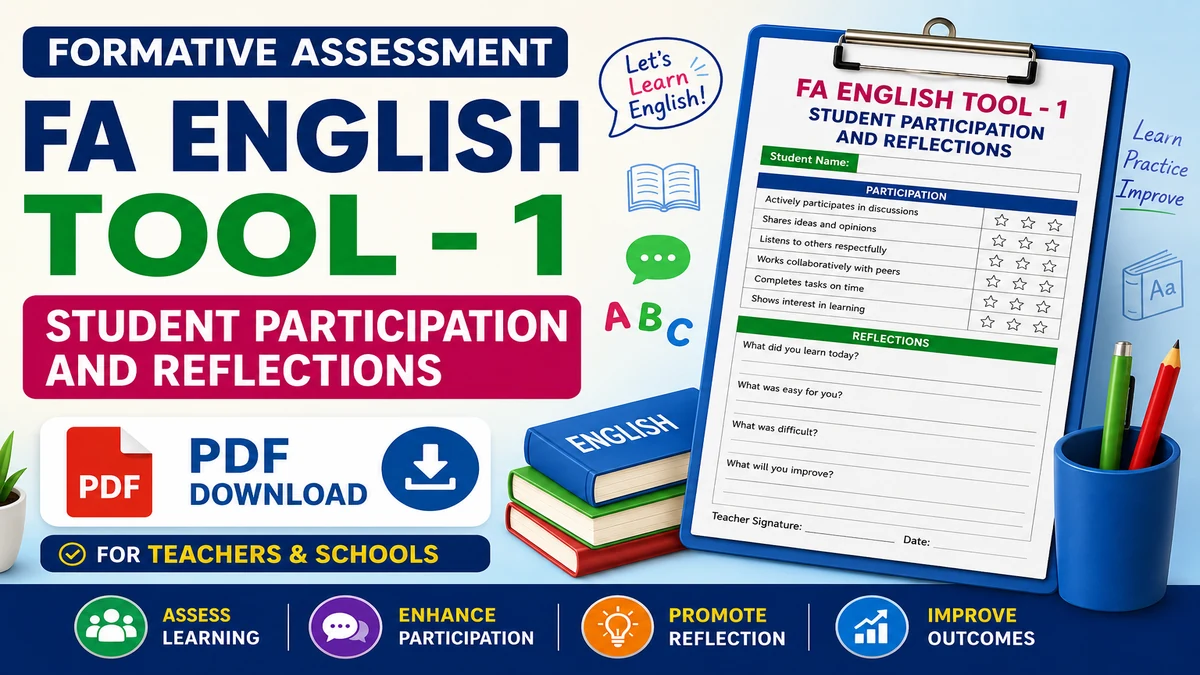
Please Note: The model reflections provided here are for reference only. Teachers and students should complete these reflections based on their own classroom teaching and learning experiences.
Table of Contents
- Overview of Formative Assessments (FAs)
- Assessment Tools for Class I & II
- Assessment Tools for Class III to X
- Focus: FAs English Tool 1 – Student Participation and Reflections
- Download FAs English Tool 1 – Student Participation and Reflections
- Frequently Asked Questions (FAQs)
Download FAs English Tool 1 – Student Participation and Reflections
Access the necessary materials for FAs English Tool 1. These resources are designed to assist in implementing the tool effectively in the classroom.
Please note: Files are added as they become available. Check back for the latest versions.
| Class | Model / Version | Download Link |
|---|---|---|
| 1st Class | Tool 1 Model | Download PDF |
| 2nd Class | Tool 1 Model | Download PDF |
| 3rd Class | Tool 1 & 3 Model | Download PDF |
| 5th Class | Tool 1 Model | Download PDF |
| 6th to 10th Class | Model 1 (Book Review) | Download PDF |
| Model 2 (Book Review) | Download PDF | |
| Model 3 (Book Review) | Download PDF |
Overview of Formative Assessments (FAs)
Formative Assessments are integral to the continuous evaluation process in Andhra Pradesh schools. These assessments are conducted using age-appropriate, activity-based tools to evaluate student performance beyond traditional written tests. The primary goal is to assess a student’s understanding, skills, and participation throughout the academic year. For detailed subject-specific model papers and resources, you can explore our comprehensive collection of FA1 Question Papers for all subjects.
Assessment Tools for Class I & II
For Classes 1 and 2, assessments focus on foundational skills in core subjects. Teachers assess and record individual student responses using the following four-tool structure for each subject.
Assessment Tools for English (Class I & II)
| Assessment Tool | Marks |
|---|---|
| Aesthetic Development | 5 |
| Cognitive Development | 5 |
| Language Skills | 5 |
| Written Test | 35 |
| Total Marks | 50 |
Assessment Tools for Mathematics (Class I & II)
| Assessment Tool | Marks |
|---|---|
| Physical Development | 5 |
| Cognitive Development | 5 |
| Pre-math Skills | 5 |
| Written Test | 35 |
| Total Marks | 50 |
Assessment Tools for Telugu (Class I & II)
| Assessment Tool | Marks |
|---|---|
| Socio-emotional Development | 5 |
| Cognitive Development | 5 |
| Language Skills | 5 |
| Written Test | 35 |
| Total Marks | 50 |
Download AP FA1 Telugu Model Papers for additional practice.
Assessment Tools for Class III to X
For classes 3 to 10, the Formative Assessment structure includes a key component: Tool 1: Children’s Participation and Reflections. This tool is subject-specific and focuses on active learning and application of knowledge. This component carries 5 marks.
| Subject | Tool | Marks Allotment |
|---|---|---|
| Languages | Library Book Review / Story Review (6-10) Book Reading (3-5) |
Review writing / fluent reading – 3 marks Presentation – 2 marks |
| Mathematics | Preparation of new mathematical questions and solutions | Generation – 3 marks Solution – 2 marks |
| Science | Lab activity | Conduction – 3 marks Lab report – 2 marks |
| Social Studies | Contemporary issues | Report writing – 3 marks Presentation – 2 marks |
For more subject-specific resources, check our AP FA1 English Model Papers and AP FA1 Hindi Model Papers.
Focus: FAs English Tool 1 – Student Participation and Reflections
This tool is designed to encourage students to actively engage with language and literature. The specific tasks vary by class level to ensure age-appropriateness.
- For Classes 3 to 5 (Book Reading): Students are assessed on their ability to read a book or passage fluently and with expression. This evaluates their pronunciation, comprehension, and reading confidence.
- For Classes 6 to 10 (Library Book Review / Story Review): Students are required to read a book or story and write a critical review. This assesses their ability to understand, analyze, and summarize content, as well as articulate their thoughts in writing.
The marks are distributed as follows:
- Review Writing / Fluent Reading (3 Marks): This assesses the quality of the written review or the fluency and accuracy of the reading.
- Presentation (2 Marks): Students are evaluated on their ability to present their review or reading effectively, demonstrating communication skills.
For detailed guidelines and to understand the broader assessment structure, you can review the official AP FA1 Exam Timetable and Syllabus.
Frequently Asked Questions (FAQs)
1. What is FAs English Tool 1 – Student Participation and Reflections?
It is a formative assessment tool for English where students participate in book reading (Classes 3-5) or write book/story reviews (Classes 6-10) to demonstrate their language skills and understanding. This tool is part of the AP SCERT assessment framework.
2. How many marks is Tool 1 for English?
FAs English Tool 1 – Student Participation and Reflections carries a total of 5 marks under the Formative Assessment structure for classes 3 to 10.
3. What is the breakup of marks for English Tool 1?
The marks are distributed as: Review Writing / Fluent Reading (3 marks) and Presentation (2 marks).
4. Is this tool used for all classes?
While the concept of “Children’s Participation and Reflections” is used for classes 3 to 10, the specific tasks vary. For classes 3-5, it is ‘Book Reading,’ and for classes 6-10, it is ‘Library Book / Story Review.’ For classes 1 and 2, the assessment tools are different, focusing on development of foundational skills.
5. Where can I find the official timetable for FA1 exams?
You can find the detailed schedule and syllabus for the FA1 exams on the official AP FA1 Self Assessment Exam Timetable page.